
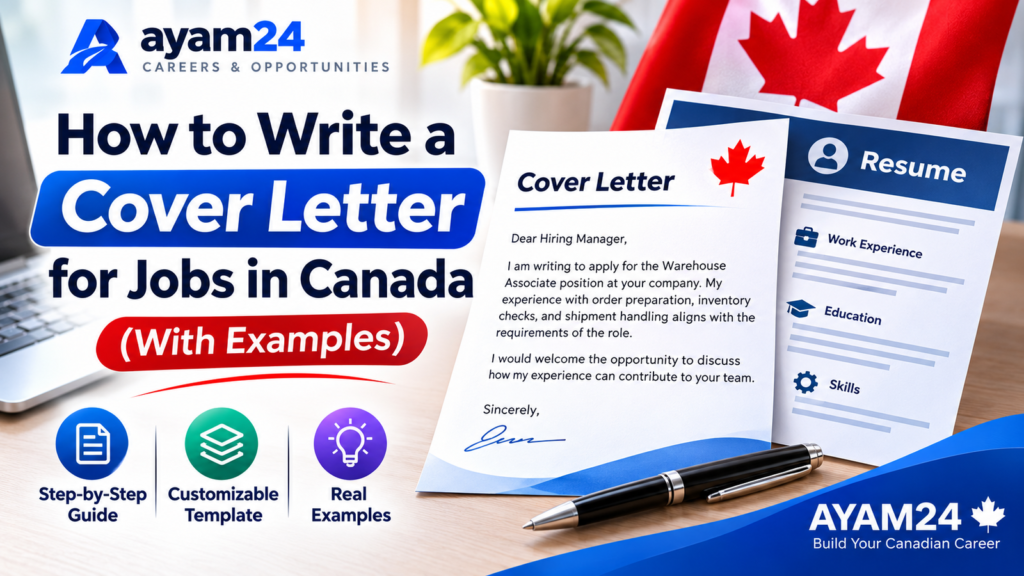
A strong resume tells an employer what you have done. A good cover letter explains why that experience matters for the job you want.
That distinction is especially important when applying for jobs in Canada. Employers may receive many applications with similar qualifications. A thoughtful cover letter gives you space to connect your background to the specific position, rather than simply repeating your resume.
You don’t need impressive language or a complicated format. You need a clear explanation of your interest in the role, evidence of relevant skills, and a professional closing.
In this guide, you’ll learn how to write a cover letter for jobs in Canada, follow a practical structure, adapt real-world examples, and avoid mistakes that can weaken your application.
What Is a Cover Letter?
A cover letter is a short document that accompanies your resume when applying for a job. It introduces your application and explains why your qualifications may be relevant to the employer.
Your resume presents your employment history, education, skills, and achievements. Your cover letter selects the most relevant details and connects them to the job advertisement.
According to the Government of Canada’s Job Bank, an effective cover letter should be concise, well written, and tailored to the company and position.
Do You Need a Cover Letter for Every Job in Canada?
Not every employer requires one. Some job advertisements specifically request a cover letter, while others ask applicants to submit only a resume or complete an online form.
When a cover letter is required, follow the instructions carefully. If it is optional, consider whether you can use it to explain something meaningful that your resume does not communicate clearly.
For example, a cover letter may be particularly useful when you are:
- Applying for a position that closely matches your experience.
- Changing careers and need to explain transferable skills.
- Returning to employment after a career break.
- Applying with relevant international experience.
- Interested in a particular employer for a specific reason.
A generic letter is unlikely to add much value. The objective is to provide a useful explanation, not another document filled with repeated information.
How Long Should a Canadian Cover Letter Be?
For many conventional job applications, a cover letter of approximately three to five short paragraphs on one page is a sensible format.
This is a practical guideline, not a legal requirement. Certain employers, academic positions, or government recruitment processes may request more detailed statements.
Always prioritize the application instructions over a general formatting rule.
How to Structure a Cover Letter for Jobs in Canada
A straightforward cover letter usually has five parts.
1. Your Contact Information
Begin with the name and contact details the employer needs to identify and reach you.
Example:
[Your Full Name]
[City, Province or Country]
[Professional Email Address]
[Telephone Number]
You can include the date and the employer’s name when appropriate. There is generally no need to include sensitive personal details such as your Social Insurance Number, marital status, or date of birth.
2. A Professional Greeting
If the job advertisement provides a hiring manager’s name, use it accurately.
For example:
Dear Ms. [Last Name],
If no name is available, a professional alternative is:
Dear Hiring Manager,
Do not guess the recipient’s name or title. A simple, accurate greeting is better than an incorrect personalized one.
3. An Opening That Identifies the Job
Your opening paragraph should explain which position you are applying for and introduce your most relevant qualification.
Weak opening:
I am writing to apply for a job at your company. I am a motivated person and would like an opportunity.
This could be sent to almost any employer. It does not identify a specific position or useful qualification.
Stronger opening:
I am applying for the Warehouse Associate position advertised on your careers page. My experience with order preparation, inventory records, and shipment handling aligns with several responsibilities described in the posting.
This version immediately connects the application with the employer’s requirements. Use it only if the experience described is accurate for you.
4. Evidence That You Can Do the Work
In the main paragraph, select one or two qualifications that matter most for the role.
Rather than repeating a list of responsibilities from your resume, explain how you applied your skills.
For example:
In my previous role, I prepared customer orders, checked inventory information, and coordinated with colleagues to meet dispatch schedules. This experience strengthened my attention to detail and understanding of safe warehouse procedures.
This is more convincing than simply saying you are hardworking and organized.
When you have documented results, you can mention them. Avoid inventing percentages, performance figures, or achievements.
5. A Professional Closing
End by expressing your interest in discussing the position and thanking the employer for considering your application.
Example:
Thank you for reviewing my application. I would welcome the opportunity to discuss how my experience relates to the requirements of the position.
Finish with a professional sign-off such as Sincerely or Best regards, followed by your name.
Free Canadian Cover Letter Template
The following template is designed for a standard job application. Copy it into Word or another document editor, replace every placeholder, and rewrite the example wording to reflect your genuine qualifications.
[Your Full Name]
[City, Province or Country]
[Email Address]
[Telephone Number]
[Date]
[Hiring Manager’s Name, if Known]
[Company Name]
Subject: Application for [Exact Job Title]
Dear Hiring Manager,
I am writing to apply for the [Job Title] position at [Company Name]. With experience in [Relevant Field or Skill], I believe my background aligns with the responsibilities described in your job posting.
In my previous role at [Employer or Organization], I [Describe a Relevant Responsibility or Achievement]. Through this work, I developed skills in [Skill One] and [Skill Two], which I would bring to the position.
I am particularly interested in this opportunity because [Explain a Specific, Genuine Reason Related to the Company or Role]. I would welcome the opportunity to contribute my experience and continue developing my professional skills.
Thank you for considering my application. I would appreciate the opportunity to discuss how my qualifications meet your requirements.
Sincerely,
[Your Full Name]
Before submitting: Replace every bracketed field. Do not claim employment experience, achievements, or knowledge of a company that you cannot substantiate.
Example 1: Cover Letter for a Warehouse Job in Canada
This fictional example illustrates how an applicant with relevant warehouse experience could write a concise letter. It is not a real applicant’s employment history.
Subject: Application for Warehouse Associate
Dear Hiring Manager,
I am interested in the Warehouse Associate position at [Company Name]. My experience with order picking, inventory checks, and shipment preparation closely matches the duties outlined in your advertisement.
In my previous warehouse role, I prepared customer orders, checked stock information against order records, and worked with colleagues to organize outgoing shipments. These responsibilities required accuracy, reliable communication, and careful attention to workplace safety procedures.
Your position interests me because it emphasizes organized warehouse operations and teamwork. I would welcome the chance to apply my experience in a role where dependable order handling and safe working practices are important.
Thank you for considering my application. I would be pleased to discuss my qualifications further.
Sincerely,
[Your Full Name]
Why Does This Example Work?
The letter identifies the vacancy, connects relevant experience to the duties, and gives the employer concrete information to consider.
It avoids unsupported claims such as being the best warehouse employee or guaranteeing exceptional results.
If your own experience differs, change the descriptions accordingly rather than copying them unchanged.
Example 2: Cover Letter for an Entry-Level Job
Applicants without extensive paid work experience can still write a useful cover letter by focusing on practical training, projects, volunteer work, and transferable skills.
Subject: Application for Customer Service Assistant
Dear Hiring Manager,
I am applying for the Customer Service Assistant position at [Company Name]. As a recent graduate with experience supporting community activities and working on team-based projects, I am interested in developing my career in a customer-facing role.
During my studies and volunteer activities, I communicated with participants, organized information, and helped resolve practical questions. These experiences strengthened my communication, organization, and problem-solving skills.
I am interested in this position because it offers an opportunity to use these skills while learning your customer service processes. I would welcome the chance to contribute to a supportive and professional team.
Thank you for your consideration. I look forward to the possibility of discussing my application.
Sincerely,
[Your Full Name]
This example demonstrates that an applicant can show relevant potential without pretending to have professional experience they have not gained.
Example 3: A Cover Letter for a Career Change
If you’re moving into a new industry, explain which skills from your previous work are relevant to your target position.
Imagine a restaurant supervisor applying for an administrative coordinator position.
Instead of focusing on restaurant-specific duties, the applicant might highlight scheduling, documentation, inventory coordination, staff communication, and handling competing priorities.
Example paragraph:
Although my recent experience has been in restaurant operations, many of my responsibilities involved scheduling, maintaining records, coordinating staff, and resolving daily operational issues. I am interested in applying those transferable skills to an administrative coordinator role.
A successful career-change letter should connect real experience with the new role while acknowledging any required qualifications or training.
How to Tailor a Cover Letter to a Canadian Job Posting
Before writing your letter, take a few minutes to study the vacancy.
Consider an administrative assistant posting that emphasizes scheduling, document preparation, communication, and Microsoft Office.
Compare the job requirements with your actual experience.
| Job requirement | Evidence to consider |
|---|---|
| Scheduling | Appointments, staff schedules, or event coordination you actually managed |
| Document management | Records, reports, or files you maintained |
| Communication | Relevant customer, colleague, or stakeholder interactions |
| Microsoft Office | Specific software and tasks you have performed |
Select the strongest matches rather than trying to force every requirement into your letter.
The employer should be able to recognize the connection between the vacancy and your qualifications without reading a long explanation.
How to Send a Cover Letter by Email
Some employers ask for a cover letter as an attachment. Others accept a short application message in the body of an email.
Follow the instructions in the job advertisement. If a separate cover letter is requested, attach it in the specified format.
Sample Job Application Email
Subject: Application for [Job Title] — [Your Full Name]
Dear Hiring Manager,
I am writing to apply for the [Job Title] position at [Company Name]. My background in [Relevant Experience or Field] aligns with the qualifications described in the posting.
I have attached my resume and cover letter for your review, as requested.
Thank you for your time and consideration.
Best regards,
[Your Full Name]
[Telephone Number]
If the employer asks you to put the complete cover letter in the email body, use the full letter there instead of a short message that duplicates an unnecessary attachment.
Can Foreign Applicants Write a Cover Letter for Jobs in Canada?
Yes. A candidate living outside Canada can prepare a professional cover letter for a Canadian employer.
Describe your genuine experience, qualifications, and interest in the position. Use accurate contact details and your real country of residence.
However, a cover letter does not create work authorization or guarantee eligibility for employment in Canada.
Not every vacancy is open to applicants located abroad. Review the employer’s eligibility requirements before applying.
If an employer requests information about your legal authorization to work in Canada, answer accurately. Do not claim to hold a work permit or immigration status that you do not have.
International applicants can consult Job Bank’s guidance for foreign candidates for information about searching for suitable opportunities.
Common Cover Letter Mistakes to Avoid
Using the Same Letter for Every Employer
Replace general statements with information relevant to the actual role and organization. A few specific sentences are more useful than a full page of generic praise.
Repeating Your Resume Word for Word
Your letter should explain the importance of selected experiences, not reproduce every employment entry.
Making Unsupported Claims
Avoid exaggerating your experience or inserting invented achievements, certifications, and performance figures.
Writing Too Much
Include enough detail to demonstrate suitability, but remove information that doesn’t help the employer evaluate your application.
Sending the Letter to the Wrong Company
Check the employer’s name and job title carefully, especially when adapting a document from a previous application.
Ignoring the Application Instructions
Follow requirements for file format, document naming, deadlines, and online screening questions.
Cover Letters for Government Jobs in Canada
Government recruitment processes may differ from private-sector hiring.
Some competitions require detailed screening responses that demonstrate how you meet particular qualifications. A cover letter alone may not satisfy those requirements.
The Public Service Commission’s guidance on applying for Government of Canada jobs explains how to complete applications and support your answers with specific examples.
Read each posting carefully rather than assuming that the same documents are required for every position.
Frequently Asked Questions
Is a Cover Letter Mandatory in Canada?
No universal rule requires one for every job. Employers set their own application requirements. Submit a cover letter when requested and consider adding one when it would provide meaningful information.
Should I Include a Photo in My Cover Letter?
For an ordinary professional job application, a photograph is generally unnecessary. Focus on your qualifications and experience.
Can I Use the Same Cover Letter Template for Different Jobs?
Yes, you can reuse a basic structure. However, you should adapt the introduction, qualifications, and reasons for applying to each position.
Should I Mention Salary Expectations?
Include salary expectations only when requested or when they are relevant to the employer’s stated application process.
What If I Don’t Know the Hiring Manager’s Name?
Use a neutral greeting such as “Dear Hiring Manager” rather than guessing a name or title.
Should I Submit My Cover Letter as PDF or Word?
Follow the employer’s instructions. PDF can preserve document formatting, while some application systems request Word documents or plain-text entries.
Can I Use AI to Help Write My Cover Letter?
AI can help organize a draft or improve language, but you remain responsible for checking every claim, adapting the content to the employer, and ensuring that the letter accurately represents your background. Avoid submitting generic or fabricated statements.
Final Cover Letter Checklist
- Confirm the exact job title and employer name.
- Use accurate contact information.
- Explain why your experience relates to the position.
- Include one or two specific, truthful examples.
- Use a professional and natural tone.
- Keep the letter concise and easy to read.
- Check grammar, spelling, and formatting.
- Follow the employer’s submission instructions.
- Review the final file before sending it.
Final Thoughts
A successful cover letter does not need to sound extraordinary. It needs to make a credible connection between your experience and the job you want.
Start with the employer’s requirements, select the experiences that matter most, and explain them in straightforward English. A concise, tailored letter can add useful context to your resume and help the employer understand your application.
If you are still preparing your resume, explore these related AYAM24 guides:
- How to Write a Canadian-Style Resume (With Examples)
- Free Canadian Resume Templates (Word & PDF): 3 Editable Options
Official Sources and Further Reading
- Government of Canada Job Bank — How to Apply for Jobs
- Job Bank — How to Write a Good Resume
- Job Bank — Foreign Candidates
- Government of Canada — How to Apply for Federal Government Jobs
Information reviewed: November 9, 2026. The cover letter examples are illustrative and should be adapted to each applicant’s actual experience and the employer’s requirements.