
You have prepared your resume, researched the employer, and arrived at the interview ready to explain your qualifications. Then the interviewer asks: “Tell me about a time you solved a problem.”
You know you have relevant experience, but how do you explain it without losing track of the question or giving an answer that sounds too general?
That’s where the STAR interview method can help. It provides a simple structure for describing a real situation, explaining your responsibility, showing what you did, and describing the outcome.
In this guide, you’ll learn how to use STAR in Canadian job interviews, explore practical examples for different occupations, and prepare truthful answers based on your own experience.
You’ll also find a preparation worksheet, common mistakes, and guidance for entry-level and international applicants.
Important: All sample scenarios in this article are fictional educational examples. They are not real applicants’ verified experiences. Use the structure, but replace the details with events that genuinely happened to you.
What Is the STAR Interview Method?
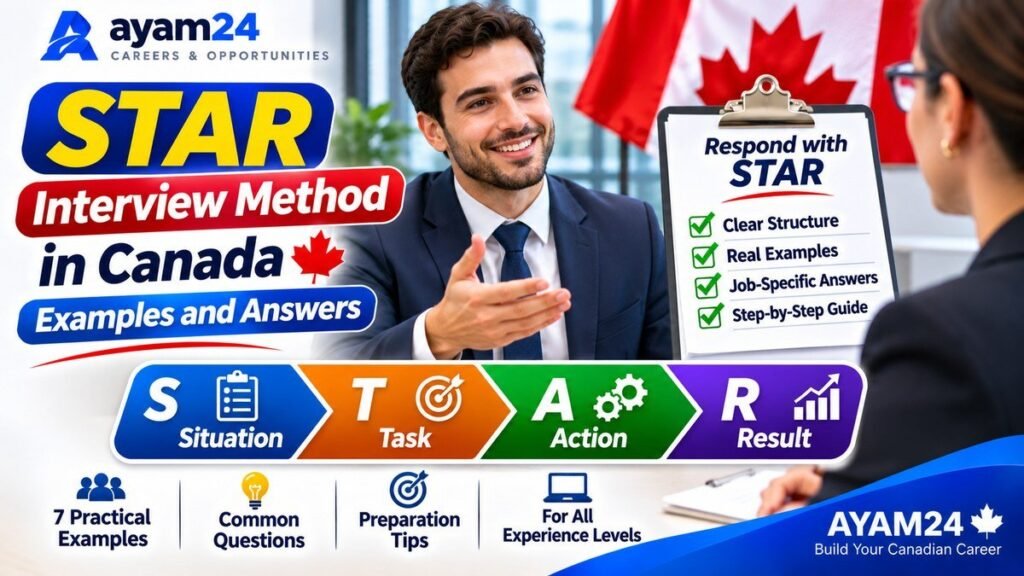
STAR stands for Situation, Task, Action, and Result.
It is a structured way to respond to behavioural interview questions, particularly those asking you to describe something you have done in the past.
S — Situation
Describe the background. What was happening, and what made the situation important?
T — Task
Explain your responsibility or the specific challenge you needed to address.
A — Action
Describe the steps you personally took. This is usually the most important part of your answer.
R — Result
Explain the outcome of your actions, including what you learned when relevant.
The Government of Canada’s Public Service Commission recommends preparing STAR examples that demonstrate the qualifications assessed during federal recruitment.
The National Research Council Canada also recommends explaining specific situations, responsibilities, actions, and outcomes when answering behavioural competency questions.
STAR is a preparation technique, not a legal requirement for every job interview in Canada. Employers may use different assessment methods.
When Should You Use the STAR Method?
STAR is most useful for questions that ask you to recall a real experience.
Common examples include:
- Tell me about a time you solved a difficult problem.
- Describe a situation where you worked under pressure.
- Give an example of a conflict you resolved.
- Tell me about a mistake you made and what you learned.
- Describe a time you showed initiative.
- Tell me about a situation where teamwork was important.
- Give an example of how you adapted to a change.
These questions are often called behavioural interview questions because they explore how you behaved in previous situations.
STAR is not necessarily the best structure for every question. For example, “What software have you used?” may need a direct technical answer. A hypothetical question such as “What would you do if a customer became angry?” asks about a proposed response rather than a past event.
STAR Interview Examples: Quick Navigation
- Handling a difficult customer
- Solving an inventory problem
- Managing competing deadlines
- Working effectively in a team
- Learning from a mistake
- STAR example without paid work experience
- Resolving a workplace disagreement
STAR Example 1: Handling a Difficult Customer
Interview question: “Tell me about a time you dealt with an unhappy customer.”
Suitable for: Customer service, retail, hospitality, reception, and call centre positions.
Situation
A customer contacted the company because an order had not arrived by the expected delivery date.
Task
The employee needed to investigate the status of the order, communicate accurately with the customer, and follow company procedures.
Action
The employee reviewed the order records, contacted the relevant delivery team, checked the available tracking information, and explained the confirmed next steps to the customer.
Result
The customer received an updated delivery status and understood how the company would handle the remaining issue.
Complete Sample STAR Answer
In my previous customer service role, a customer contacted us because an order had not arrived when expected. I was responsible for checking the available information and helping the customer understand what would happen next. I reviewed the order record, contacted our delivery team, and confirmed the latest shipment status. I then explained the update to the customer and documented the interaction. The customer received accurate information and knew the next steps for following up on the delivery.
Why this works: The answer explains the problem, identifies the applicant’s responsibility, describes specific actions, and ends with a realistic outcome.
It does not invent a refund, claim that every customer was satisfied, or exaggerate the employee’s authority.
STAR Example 2: Solving an Inventory Problem
Interview question: “Describe a time you identified a problem and helped resolve it.”
Suitable for: Warehouse associates, inventory clerks, stock assistants, and logistics workers.
Situation
During a routine inventory check, the recorded quantity of a product did not match the physical stock.
Task
The employee needed to verify the discrepancy and report reliable information before the inventory record was finalized.
Action
The employee counted the items again, checked recent receiving documents, reviewed recorded stock movements, and informed the supervisor of the discrepancy.
Result
The team identified an incorrect record entry and corrected the inventory information through the normal process.
Sample STAR Answer
During a warehouse stock check, I noticed that the physical item count did not match the inventory record. My responsibility was to verify the information before the count was completed. I recounted the items, checked the receiving documents, and reviewed recent stock movements. I then shared the discrepancy with my supervisor. We identified an entry that needed correction, and the inventory record was updated before the process was finalized.
How to improve your own answer: If you have an accurate and documented result, such as a corrected quantity or reduced discrepancy rate, you can mention it. Do not invent percentages or performance statistics.
STAR Example 3: Managing Competing Deadlines
Interview question: “Tell me about a time you had to manage several tasks under pressure.”
Suitable for: Administrative assistants, office coordinators, receptionists, and operations support staff.
Situation
An administrative employee received several urgent requests while preparing documents for an afternoon meeting.
Task
The employee needed to complete the meeting documents while responding to time-sensitive requests without overlooking important details.
Action
The employee reviewed deadlines, identified the tasks that affected other colleagues, confirmed priorities with the supervisor, and organized the work into manageable steps.
Result
The meeting materials were prepared by the required time, and colleagues received updates on the other outstanding requests.
Sample STAR Answer
On a busy day in my administrative role, I was preparing documents for an afternoon meeting when several additional requests arrived. I needed to manage the new tasks while completing the scheduled work. I reviewed the deadlines, confirmed the priorities with my supervisor, and organized the tasks according to urgency. I completed the meeting materials on time and communicated the status of the remaining requests to the relevant colleagues.
Key lesson: An effective answer shows how you made decisions and communicated. Simply saying “I work well under pressure” does not provide the same evidence.
STAR Example 4: Working Effectively in a Team
Interview question: “Describe a time you worked with others to complete an important task.”
Suitable for: Hospitality, retail, warehouse operations, office support, and many other professions.
Situation
A restaurant team was preparing for a busy service period while a colleague was unexpectedly absent.
Task
The employee needed to support service preparation while coordinating responsibilities with the available team members.
Action
The employee discussed priorities with the supervisor, helped prepare the service area, supported a colleague with time-sensitive tasks, and communicated changes during the shift.
Result
The team completed the necessary preparation and continued service with a clearer division of responsibilities.
Sample STAR Answer
During a busy shift at a restaurant, a colleague was absent and the team had fewer people available than expected. I needed to complete my assigned preparation while supporting the rest of the team. I checked priorities with the supervisor, helped another colleague with time-sensitive setup tasks, and communicated updates as the shift progressed. We completed the essential preparation and were able to continue service with responsibilities clearly assigned.
Important: Although teamwork is the subject, explain what you contributed. Employers evaluating your answer need to distinguish your actions from the group’s overall performance.
STAR Example 5: Learning From a Mistake
Interview question: “Tell me about a mistake you made at work and how you handled it.”
Suitable for: Administrative, customer support, data entry, and many other positions.
Situation
An employee noticed that a customer reference number had been entered incorrectly into an internal record.
Task
The employee needed to correct the information and check whether the error affected related records.
Action
The employee informed the appropriate colleague, followed the record correction procedure, checked related information, and introduced a final verification step when entering reference numbers.
Result
The incorrect entry was corrected, and the employee adopted a more consistent checking process for future records.
Sample STAR Answer
In a previous administrative position, I noticed that I had entered the wrong reference number into an internal record. I was responsible for correcting the mistake and checking whether it affected other documents. I informed the appropriate colleague, followed our correction procedure, and reviewed the related entries. The error was corrected, and I began checking reference numbers against the original document before saving similar records.
Why this is effective: The applicant acknowledges responsibility, describes corrective action, and explains a practical lesson.
Do not fabricate a harmless mistake for the interview. Choose an appropriate real example and avoid disclosing confidential information.
STAR Example 6: Answering Without Paid Work Experience
Interview question: “Give an example of a time you showed leadership or initiative.”
Suitable for: Students, recent graduates, and first-time job seekers.
You do not necessarily need paid employment to demonstrate professional skills. Relevant situations can come from school, volunteering, training, or community projects.
Situation
A student group was preparing a presentation, but responsibilities had not been clearly assigned.
Task
One student needed to help the group organize the remaining work before the presentation deadline.
Action
The student suggested dividing the presentation into sections, helped assign tasks based on available skills, and set a shared deadline for reviewing the final material.
Result
The group completed the presentation and submitted it by the required deadline.
Sample STAR Answer
During a group project at college, our team had a presentation deadline but had not yet divided the work. I suggested organizing the project into separate sections so everyone would know what to prepare. I helped create a task list, coordinated our progress updates, and arranged a final review before submission. We completed the presentation by the deadline, and I learned how useful clear responsibilities can be when working in a team.
Key point: Entry-level candidates should describe genuine experiences that demonstrate the qualities the employer needs. You do not need to invent professional experience to prepare a STAR answer.
STAR Example 7: Resolving a Workplace Disagreement
Interview question: “Describe a disagreement with a coworker and explain how you handled it.”
Suitable for: Customer service, hospitality, administration, and team-based roles.
Situation
Two colleagues had different understandings of who was responsible for updating a shared task record.
Task
The employee needed to clarify responsibilities so the information would be updated consistently.
Action
The employee discussed the issue privately with the colleague, compared their understanding of the process, and asked the supervisor to confirm the correct division of responsibility.
Result
The team clarified the process and reduced confusion about who should update the records.
Sample STAR Answer
In a previous role, a coworker and I had different understandings of who should update a shared task record. I wanted to resolve the confusion before information was missed. I spoke with my colleague to understand their perspective, explained my understanding, and asked our supervisor to clarify the procedure. Once responsibilities were confirmed, we followed the agreed process and avoided further confusion about the updates.
Practical lesson: Focus on your communication and actions. Avoid describing the other person as incompetent or blaming them for the disagreement.
What Makes a Strong STAR Answer?
The best STAR answers are not necessarily the longest. They contain enough specific information for the interviewer to understand what happened and evaluate the candidate’s contribution.
Compare these two versions of an answer to a teamwork question.
Weak Answer
I’m very good at teamwork. I always help my colleagues, and we complete our tasks successfully.
This answer expresses a positive quality but provides no specific example.
Stronger Answer
During a busy warehouse shift, several orders needed to be prepared before a scheduled pickup. I was responsible for verifying quantities and checking labels. I organized my assigned orders by dispatch priority and informed colleagues when an item was missing. We completed the required checks and prepared the orders for pickup.
The stronger version describes the situation, the applicant’s responsibility, the actions taken, and an identifiable outcome.
How Long Should a STAR Answer Be?
There is no universal Canadian rule requiring STAR answers to last a specific number of minutes.
For a conversational interview, practising an initial response of roughly one to two minutes can be a useful starting point. More complex examples or structured assessments may require additional detail.
Focus on giving enough context to understand the example while spending meaningful time explaining your own actions.
If the interviewer asks follow-up questions, answer them directly and provide clarification.
The National Research Council notes that interview panels may ask additional questions to understand the applicant’s precise contribution. Such follow-ups are part of evaluating the experience being described.
How to Prepare STAR Answers Before Your Interview
Step 1: Study the Job Advertisement
Identify the skills and competencies the employer is likely to assess, such as communication, teamwork, initiative, judgment, accuracy, or problem-solving.
Don’t prepare only generic stories. Choose situations that are relevant to the particular role.
Step 2: Create a List of Real Experiences
Think about examples from work, education, volunteering, training, or projects.
Useful experiences include solving a problem, learning a new system, supporting a colleague, meeting a deadline, handling a complaint, or improving a routine process.
Write down several possible examples so you aren’t forced to use the same story for every question.
Step 3: Break Each Experience Into STAR
For each situation, write a brief explanation of the context, your responsibility, your actions, and the result.
Make sure the Action section explains what you personally did.
Step 4: Check the Facts
Confirm employment dates, responsibilities, accomplishments, and any figures you mention.
Never invent performance statistics, promotions, certifications, or outcomes.
Step 5: Practise Speaking Naturally
Use your notes as a guide, then practise explaining the situation aloud without reading a memorized script word for word.
The goal is a clear, accurate explanation that you can adapt to different interview questions.
Free STAR Interview Practice Worksheet
Use the following questions to prepare your own examples. You can copy the worksheet into a document or notebook and complete it before the interview.
My STAR Interview Example
Target job: [Job Title]
Skill being assessed: [Teamwork / Problem-Solving / Communication / Other]
S — Situation
Where did the situation happen? What was the challenge?
[Describe the background]
T — Task
What were you personally responsible for?
[Describe your responsibility]
A — Action
What steps did you take? What decisions did you make?
[Describe your specific actions]
R — Result
What happened afterward? What did you learn?
[Describe the accurate outcome]
Final check: Does this example clearly demonstrate the skill required for the job?
A useful practice exercise is to prepare four or five genuine stories that demonstrate different abilities. You can adapt each story to a relevant question without changing the underlying facts.
STAR Interviews for Government of Canada Jobs
The STAR method is particularly relevant to some federal recruitment processes because employers may assess defined competencies through structured questions.
The Public Service Commission advises candidates to review the qualifications listed in their assessment invitation and prepare examples showing how they meet those requirements.
When discussing group projects, explain your personal role. The interviewer needs to understand what you did, not just what the team achieved.
STAR can also be useful when responding to written screening questions. However, an online application may require dates, locations, detailed evidence, and answers to every part of the question.
Read the official guidance before applying:
- Public Service Commission — Testing and Accommodation Measures
- Government of Canada — How to Apply for Federal Jobs
Not all private-sector interviews use a formal STAR framework, and STAR is not a guarantee of employment.
Can International Applicants Use the STAR Method?
Yes. Candidates applying for Canadian jobs from other countries can use relevant examples from their own work, education, and training.
You do not need Canadian work experience to explain how you solved a problem, worked with colleagues, or managed responsibilities elsewhere.
For example, an applicant who worked in a warehouse outside Canada can use an accurate inventory problem as a STAR example if it demonstrates skills relevant to the advertised position.
Be prepared to explain unfamiliar job titles, workplace processes, or qualifications in clear language.
Always remain truthful about your professional licences and current authorization to work in Canada. A strong interview response does not replace immigration eligibility or occupational licensing requirements.
For information about identifying suitable vacancies, consult Job Bank’s information for foreign candidates.
Common STAR Interview Mistakes to Avoid
1. Giving Too Much Background
The interviewer needs enough information to understand the situation, but not a long explanation of every event leading up to it.
Keep the introduction brief and focus on the relevant challenge.
2. Talking About the Team Without Explaining Your Role
Using “we” is natural when discussing teamwork, but it can make your individual contribution unclear.
Explain what you personally did, even when the final achievement belonged to the group.
3. Describing Actions Without a Result
Don’t end the answer immediately after explaining the steps you took.
Tell the interviewer what happened, whether the issue was resolved, what changed, or what you learned.
4. Inventing Numbers or Outcomes
Some sample answers online contain impressive statistics. Never copy figures that do not reflect your real experience.
An honest qualitative result is better than an unsupported claim.
5. Using the Same Story for Every Question
One situation may demonstrate several abilities, but repeating it for every competency can limit the evidence available to the employer.
Prepare different examples when possible.
6. Memorizing Answers Word for Word
A memorized answer may not address the question actually asked.
Remember the main events, actions, and result so you can explain them naturally.
7. Treating STAR as Mandatory for Every Question
STAR is useful for behavioural questions, but a simple factual question may deserve a direct answer instead.
Pay attention to the interviewer’s wording and instructions.
Frequently Asked Questions About the STAR Method
What Does STAR Stand for in an Interview?
STAR stands for Situation, Task, Action, and Result. It is a structure for explaining a real experience in a clear and organized way.
Is the STAR Method Used in Canadian Job Interviews?
Yes. Canadian employers may use behavioural interview questions, and several Government of Canada recruitment resources recommend STAR for preparing answers. It is not mandatory in every interview.
Can I Use STAR Without Previous Work Experience?
Yes. Relevant examples can come from school projects, volunteer activities, training, community work, or other genuine experiences.
Does Every STAR Answer Need a Positive Result?
No. Some authentic experiences involve difficulties or incomplete outcomes. Explain what happened accurately, how you responded, and what you learned.
Can I Use the Same Example for Different Questions?
You may be able to use a relevant experience to demonstrate more than one skill, but prepare several different examples to show a broader range of abilities.
How Many STAR Examples Should I Prepare?
There is no universal required number. Start with a few strong, truthful examples that cover the main skills mentioned in the job posting. More complex interviews may require additional preparation.
Should I Include Numbers in My STAR Answers?
Use numbers when they are relevant and accurate. If you do not have reliable figures, explain the outcome clearly without inventing statistics.
Can STAR Help With Written Job Applications?
Yes. The structure can help organize evidence for screening questions, including some federal government applications. Always follow the specific questions, word limits, and document requirements.
What Is the Difference Between STAR and a Hypothetical Interview Answer?
STAR generally describes a real past event. A hypothetical or situational question asks what you would do in a possible future scenario. Follow the format appropriate to the question.
Final STAR Interview Preparation Checklist
- I understand the four parts of the STAR method.
- I have reviewed the job description and relevant competencies.
- My examples are based on actual experiences.
- I can explain my own role and decisions.
- I have included an accurate result or lesson.
- I have checked any achievements and figures.
- I can adapt my answers to different questions.
- I have prepared examples for several relevant skills.
- I have practised speaking clearly and naturally.
- I understand the interviewer’s instructions and assessment format.
Final Thoughts
The STAR interview method is useful because it turns a broad statement about your abilities into a specific explanation of how you demonstrated them.
Instead of simply telling an employer that you’re organized, reliable, or good at teamwork, you can describe a genuine situation that shows those qualities in action.
When preparing for your next interview in Canada, select a few experiences relevant to the position, write down the Situation, Task, Action, and Result for each, and practise explaining them clearly.
Your goal isn’t to deliver a perfect script. It’s to help the interviewer understand what you actually did and what you can contribute.
Related AYAM24 Interview Guides
Continue your preparation with these related articles:
- 20 Common Job Interview Questions and Answers in Canada
- How to Introduce Yourself in a Job Interview in Canada
Official Sources and Further Reading
- Government of Canada — Testing and Interview Preparation
- National Research Council Canada — Behavioural Competency Interview Questions
- Government of Canada — How to Apply for Federal Government Jobs
- Job Bank — Job Search and Interview Preparation Resources
Editorial review: November 9, 2026. All STAR examples in this guide are fictional learning scenarios. Interview formats and employment requirements vary by employer, occupation, and jurisdiction.