
Arriving in Canada with a job opportunity can be an important moment in your career. But before your first shift, there are several practical details you need to organize.
Do you have the correct work authorization? Have you applied for your Social Insurance Number (SIN)? Does your employment agreement match the job you accepted? How will you receive your salary, and what happens if you need medical care?
These questions are particularly important for foreign workers who are unfamiliar with Canadian employment procedures.
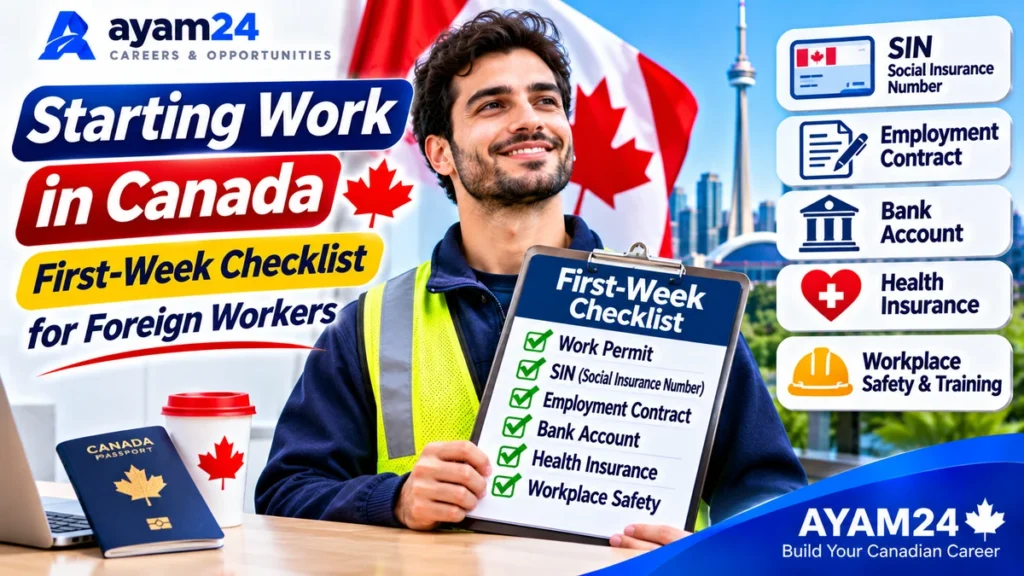
This guide explains what you need to know about starting work in Canada, including the first-week steps involving your work permit, SIN, employment contract, bank account, payroll deductions, health insurance, workplace safety, and personal documents.
It also provides a practical checklist and examples to help you avoid common mistakes.
Important: This article provides general employment and settlement information. Requirements vary by immigration status, employer, province, territory, and applicable program. Always follow current government instructions and the specific conditions of your work authorization.
Before Your First Day: What Should You Check?
Not every newcomer follows the same process. Some foreign workers arrive with an employer-specific work permit. Others already live in Canada and hold valid authorization that allows them to accept employment.
Your first priority is confirming that you are legally permitted to perform the job you are about to start.
Once your authorization is confirmed, focus on the documents and arrangements needed for employment, payroll, health coverage, and everyday life.
Quick First-Week Checklist
| Task | When to address it |
|---|---|
| Verify work permit conditions | Before starting work |
| Apply for or update SIN | As soon as possible, within applicable requirements |
| Review employment agreement | Before or when employment begins, as required |
| Arrange payroll and banking | During onboarding, before the first payment |
| Check health insurance coverage | Immediately upon arrival or eligibility |
| Complete workplace orientation | Before performing duties requiring training |
| Record hours and review payslips | From the first shift and each pay period |
This is an organizational checklist, not a universal government-mandated seven-day schedule.
1. Confirm That Your Work Permit Allows You to Start the Job
If you applied for a work permit from outside Canada, you may have received a Port of Entry Letter of Introduction after your application was approved.
That letter is not the actual work permit.
For many applicants entering Canada to begin employment, a Canada Border Services Agency officer issues the work permit at the port of entry after completing the required assessment.
IRCC advises workers to check their permit carefully before leaving the border.
What Should You Verify?
- Your name and personal information.
- The permit’s expiry date.
- The employer listed, if applicable.
- Any occupation or work location conditions.
- Any medical or other employment restrictions.
An employer-specific work permit generally restricts employment according to the conditions written on the document.
An open work permit usually offers more flexibility, but it may still include restrictions.
Do not begin work that falls outside your authorization. If a condition appears incorrect, seek clarification through the appropriate immigration process.
Official resource: IRCC — Arriving in Canada With a Work Permit.
2. Apply for Your Social Insurance Number (SIN)
The Social Insurance Number, commonly called SIN, is a nine-digit number used for employment, income tax administration, and certain government programs.
You will need it for payroll and other authorized purposes when working in Canada.
For temporary residents, SINs generally begin with the number 9 and have an expiry date corresponding to the immigration document authorizing employment.
How to Apply for a SIN
Service Canada offers several application methods:
- Online.
- In person at a Service Canada location.
- By mail.
The appropriate documents depend on your immigration status and the application method.
Temporary residents generally need a valid immigration document authorizing work and an acceptable secondary identity document, such as a passport.
Do not assume an email confirming immigration approval can replace the required immigration document.
Step-by-Step SIN Application
- Open the official Service Canada SIN application page.
- Select the temporary resident category if it applies to you.
- Choose online, in-person, or mail application.
- Review the personalized document requirements.
- Provide the required identity and immigration documents.
- Submit your application using the official process.
- Retain the confirmation and follow the instructions for receiving or viewing your SIN.
Apply here: Service Canada — Apply for a Social Insurance Number.
How Much Does a SIN Cost?
Applying for or updating a SIN is free.
Do not pay a third-party website that claims to sell a faster SIN application or an official SIN card.
Service Canada no longer issues new plastic SIN cards. Your number can be confirmed through the available official channels.
Can You Start Working Before Receiving Your SIN?
If you are already legally authorized to work in Canada, the government permits you to begin eligible employment before your SIN has been issued, provided you apply within the required period.
Service Canada explains that a worker who does not yet have a SIN must apply within three days of beginning employment and provide the number to the employer within three days after receiving it.
This exception concerns the timing of the SIN application. It does not authorize someone to work without valid immigration permission.
Whenever possible, apply for your SIN before your first working day to make payroll onboarding easier.
3. Protect Your Social Insurance Number
Your SIN is sensitive personal information.
Employers need it for legitimate payroll and tax-reporting purposes, but a recruiter generally should not ask for it during an ordinary job application or initial interview.
When Should You Be Cautious?
- A recruiter asks you to include your SIN on your resume.
- An unknown website requests your SIN to unlock job advertisements.
- Someone asks for your SIN and banking password together.
- You receive an unexpected message asking you to verify your SIN through an unfamiliar link.
Service Canada recommends sharing your SIN only when there is a legitimate reason and protecting it from identity theft.
Keep your identity documents and immigration information secure.
Official guidance: Social Insurance Number Code of Practice.
4. Review Your Employment Agreement Before Starting
Your employment agreement explains important details of the job.
Before you begin, verify that the position and working conditions match the terms you accepted.
Employment Agreement Checklist
- The employer’s legal name.
- Your job title and main responsibilities.
- Your wage or salary.
- The expected weekly hours.
- The work location.
- The employment start date.
- Any relevant accommodation or benefits arrangements.
- Other conditions or restrictions included in the agreement.
For workers hired through the Temporary Foreign Worker Program, employers have specific obligations regarding signed agreements and employment conditions.
Other employment arrangements may have different documentation requirements.
Ask for an explanation if the employer’s instructions differ significantly from your agreement.
Do not sign documents containing information you know is false or conditions you do not understand.
5. Open a Canadian Bank Account for Your Salary
A Canadian bank account can make it easier to receive wages by direct deposit, pay bills, and manage everyday expenses.
However, opening an account is not the same as obtaining work authorization, and different employers may use different lawful payment methods.
The Financial Consumer Agency of Canada explains that eligible individuals may open a bank account even if they are not Canadian citizens and, in some circumstances, even if they live outside Canada.
You must meet the bank’s identity verification requirements.
What to Compare Before Choosing an Account
- Monthly account fees.
- The number of included transactions.
- ATM withdrawal charges.
- Direct deposit availability.
- International transfer fees.
- Online and mobile banking features.
- Overdraft and other optional charges.
What Documents Might a Bank Request?
Canadian banks need to verify your identity. The acceptable documents depend on the identification rules and your circumstances.
Some combinations may include a foreign passport and other reliable documentation.
Contact the bank directly to confirm which documents it accepts and whether an in-person visit is required.
Important: Do not assume that every bank will accept a passport by itself or offer every account type to every newcomer.
Official resource: Financial Consumer Agency of Canada — Opening a Bank Account.
6. Complete Your Payroll and Tax Forms
Once you begin working, your employer may ask you to complete payroll onboarding forms.
In Canada, employees commonly complete Form TD1, the Personal Tax Credits Return, to help the employer calculate income tax deductions.
Federal and applicable provincial or territorial TD1 rules may apply depending on your employment situation.
What Information Should You Confirm?
- Your correct legal name and contact information.
- Your SIN, through a legitimate payroll process.
- The payroll schedule.
- Required TD1 information.
- Bank details, if using direct deposit.
- Any authorized deductions or benefits contributions.
Complete tax forms truthfully. For example, having more than one employer at the same time can affect which personal tax credits you should claim through payroll.
If a form is unclear, ask the employer’s payroll team or consult Canada Revenue Agency guidance.
Official resource: CRA — Form TD1 for New Employees.
7. Understand Your First Paycheque
The wage advertised in a job posting is usually not the exact amount that will appear in your bank account.
This is because gross pay and net pay are different.
Gross Pay
Gross pay is your employment income before applicable payroll deductions.
Net Pay
Net pay is the amount remaining after lawful deductions and other applicable adjustments.
Common Payroll Deductions
- Income tax.
- Canada Pension Plan (CPP) or Quebec Pension Plan (QPP) contributions, when applicable.
- Employment Insurance (EI) premiums.
- Other lawful deductions, such as eligible employee benefits contributions.
Illustrative Pay Example
Suppose a worker earns CAD $22 per hour and works 35 regular payable hours during a pay period.
Gross pay: $22 × 35 = CAD $770.
The actual take-home amount may be lower after income tax and other applicable deductions.
This is a calculation example, not a statement of the legal minimum wage or a prediction of net income.
Official resource: Financial Consumer Agency of Canada — Starting Your First Job.
8. Check Your Health Insurance Coverage
Access to public health insurance in Canada depends on the province or territory and your eligibility.
Some temporary workers qualify for provincial or territorial coverage. Others may face waiting periods or additional eligibility requirements.
Do not assume that receiving a work permit automatically activates public health coverage everywhere in Canada.
Questions to Resolve Early
- Am I eligible for public health insurance in this province or territory?
- When does coverage begin?
- Which documents do I need to register?
- What coverage do I have before my public insurance becomes active?
- Does my employer have program-specific insurance obligations?
Under the Temporary Foreign Worker Program, employers have specific obligations concerning emergency medical insurance during periods when certain workers are not covered by provincial or territorial health insurance. Exceptions and special arrangements may apply.
Do not assume that all work permit holders are covered by identical employer insurance obligations.
Official reference: Temporary Foreign Workers — Health Care and Worker Protections.
9. Complete Workplace Safety Training
Before performing unfamiliar or potentially hazardous duties, make sure you understand the training and safety procedures required for the job.
Workplace orientation may include:
- Emergency exits and evacuation procedures.
- Reporting hazards and workplace injuries.
- Required personal protective equipment.
- Safe operation of machinery and tools.
- Workplace harassment and violence policies.
- Who to contact for safety concerns.
For example, a warehouse employee should not claim forklift authorization or begin operating specialized equipment without meeting the applicable training and authorization requirements.
Safety rights and work-refusal procedures differ by jurisdiction and occupation.
If a task appears unsafe or falls outside your training, ask for clarification and follow the appropriate workplace safety procedures.
10. Keep Your Own Employment Records
Good record keeping can help you understand your wages, monitor work permit validity, and resolve misunderstandings.
You do not need a complicated system. A secure folder and a simple record of your working hours may be sufficient.
Documents Worth Keeping
- Your work permit and immigration correspondence.
- Your employment agreement.
- Pay statements.
- Work schedules and records of hours worked.
- Relevant employer correspondence.
- Training and certification records.
- Health insurance information.
- Written changes to your employment terms.
Protect documents containing your SIN, banking information, passport details, and other sensitive personal data.
Simple Work Hours Tracker
| Date | Start | End | Payable hours |
|---|---|---|---|
| Monday | 9:00 | 17:00 | 7.5 |
| Tuesday | 9:00 | 17:00 | 7.5 |
This fictional example assumes a 30-minute unpaid break on each day. Whether breaks are paid depends on the applicable employment rules and actual circumstances.
11. Know Where to Get Help if Something Goes Wrong
Temporary foreign workers have protections under applicable Canadian employment laws and immigration program requirements.
Problems may involve unpaid wages, unsafe working conditions, threats, document confiscation, or prohibited recruitment fees.
Your employer cannot personally deport you or remove your immigration status simply because you ask about your rights.
However, employment changes can affect the practical conditions of an employer-specific work permit, so immigration questions may also require attention.
Official Sources of Assistance
For concerns about abuse under the Temporary Foreign Worker Program, review Service Canada’s Temporary Foreign Worker Abuse Reporting Service.
For issues involving wages, overtime, breaks, and other employment standards, contact the relevant provincial, territorial, or federal employment standards authority.
For immigration permit conditions, consult IRCC’s Worker Rights Guidance.
If you face immediate danger in Canada, call emergency services at 9-1-1.
A Practical First-Week Plan for a New Foreign Worker
The following example is designed to help organize tasks. It does not replace employer instructions or legal deadlines.
Before Your First Shift
Verify your actual work permit and employment conditions. Review your job agreement and check how your employer expects you to complete onboarding.
During the First Few Days
Apply for your SIN if you do not already have one, complete required payroll forms, and arrange appropriate banking details.
Check health insurance eligibility and understand the coverage available to you.
During Workplace Orientation
Learn your schedule, reporting structure, workplace safety procedures, and where to get help with questions.
Before Your First Pay Date
Confirm the payroll schedule and review whether the employer has the information needed to pay you correctly.
When You Receive Your First Pay Statement
Compare the recorded hours, gross earnings, deductions, and net pay with your employment agreement and personal records.
If something does not match, request clarification and keep the relevant documents.
Common Mistakes New Foreign Workers Should Avoid
1. Starting Before Confirming Work Authorization
Do not confuse a job offer, visa, or approval letter with the permission required to perform your specific job.
2. Paying a Website to Obtain a SIN
SIN applications are free through Service Canada.
3. Sharing Your SIN With an Unknown Recruiter
Your SIN is not a normal requirement for submitting a resume or attending an interview.
4. Assuming All Canadian Provinces Have the Same Employment Rules
Wages, overtime, vacation, workplace safety procedures, and health insurance eligibility can differ.
5. Ignoring the Details of Your Pay Statement
Review your hours, wage rate, deductions, and net pay.
6. Not Checking Health Coverage
Public health insurance eligibility is not identical for every temporary foreign worker.
7. Losing Track of Permit Expiry Dates
Temporary residents should monitor their immigration documents and update their SIN records when required.
8. Working Outside Permit Conditions
An employer-specific permit generally limits which employment you may perform. Seek proper authorization before changing jobs where required.
Frequently Asked Questions About Starting Work in Canada
Do I Need a SIN Before Starting Work in Canada?
You need a SIN for employment administration. However, Service Canada permits eligible workers who are already authorized to work to begin before receiving their SIN, provided they follow the application and reporting deadlines.
Is a SIN the Same as a Work Permit?
No. The SIN is an identification number used for employment and government administration. Your immigration authorization determines whether and under what conditions you may work.
How Much Does a SIN Cost?
Service Canada does not charge a fee to apply for or renew a SIN.
Can a Foreign Worker Open a Bank Account in Canada?
Yes, eligible non-citizens can open bank accounts when they meet the applicable identification and account requirements. Contact the financial institution to confirm its procedures.
Do I Need a Job Before Opening a Bank Account?
Not necessarily. The Financial Consumer Agency of Canada explains that a person may be eligible to open an account without already having a job.
Why Is My First Paycheque Lower Than My Salary Calculation?
Net pay is generally lower than gross pay because of income tax and other applicable payroll deductions. Review your pay statement to understand the calculation.
Do Foreign Workers Pay Income Tax in Canada?
Employment income is generally subject to applicable payroll and tax rules. The precise tax obligations depend on the worker’s circumstances and relevant tax legislation.
Do All Foreign Workers Receive Public Health Insurance Immediately?
No. Eligibility and coverage start dates depend on provincial or territorial rules and individual circumstances.
Can My Employer Keep My Passport?
Employers cannot confiscate your passport or identity documents to control your employment. Seek appropriate assistance if documents are being withheld.
Do I Need to Update My SIN When My Work Permit Is Renewed?
Temporary residents generally need to update their SIN record when they receive a new immigration document with a new expiry date. Special rules may apply to eligible workers with maintained status.
Can I Change Employers During My First Week in Canada?
That depends on your permit conditions. Employer-specific permit holders generally need a new permit or other applicable authorization before starting a job with a different employer.
What If My Employment Agreement Is Different From the Job Advertisement?
Ask for clarification before proceeding. Keep written records and seek appropriate advice if the differences concern pay, duties, location, or other important conditions.
Final Checklist for Your First Week Working in Canada
- I have checked my work permit and its conditions.
- I understand the employer, role, and location I am authorized to work for.
- I have applied for or updated my SIN as required.
- I know how to protect my SIN and personal documents.
- I have reviewed my employment agreement.
- I understand my wage and expected working hours.
- I have arranged an appropriate payment method.
- I have completed the relevant payroll forms.
- I have checked my health insurance eligibility and coverage.
- I have received the workplace training required for my duties.
- I understand how to report hazards and employment problems.
- I am keeping accurate records of my hours and pay.
- I know the expiry dates of my important documents.
Final Thoughts
Starting work in Canada involves more than arriving at your workplace on the first day.
You need to understand your authorization to work, organize your SIN and payroll details, review your employment agreement, and check the health and safety protections that apply to you.
These steps can make your transition more organized and help you identify misunderstandings before they become serious problems.
Use official government resources, keep your personal documents secure, and ask questions when employment conditions are unclear.
A well-prepared first week is an important foundation for building your professional life in Canada.
Related AYAM24 Working in Canada Guides
- How to Find a Job in Canada as a Foreigner: Step-by-Step Guide
- LMIA Jobs in Canada: How to Find Legitimate Employers and Apply
- Canada Work Permit Guide: Types, Eligibility and How to Apply
- Foreign Worker Rights in Canada: Pay, Contracts, Safety and How to Get Help
Official Sources and Further Reading
- IRCC — Work Permit Arrival and Entry Requirements
- Service Canada — SIN for Temporary Residents
- Service Canada — Apply for a SIN
- Service Canada — SIN Code of Practice
- Financial Consumer Agency of Canada — Opening a Bank Account
- Canada Revenue Agency — Form TD1
- Financial Consumer Agency of Canada — Starting Your First Job
- Government of Canada — Temporary Foreign Worker Rights
- IRCC — Worker Rights and Labour Standards
Editorial review: November 9, 2026. This article provides general employment, settlement and immigration information. Eligibility, timelines, employment standards, health coverage and program requirements depend on individual circumstances and may change.