
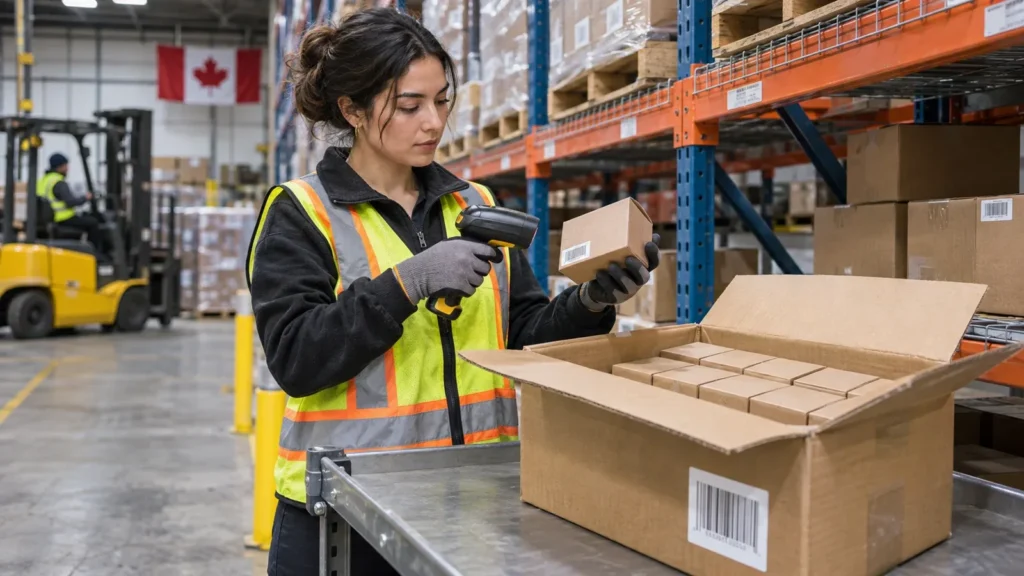
“The order says six each, but the item comes in cases of twelve. What do you pick?” Start with the quantity the customer ordered: six individual units. Then explain how you would confirm the item, the pack size and the site’s procedure for opening a case. A good interview answer shows what you would check before telling the system the order is complete.
Read the order line aloud
Imagine a training order for six rolls of blue tape. The bin holds sealed cases, each labelled as containing twelve rolls. The number six tells you how many units the customer wants. The word “each” tells you what counts as one unit. Picking six cases would send 72 rolls. Picking a single sealed case would still send twice the requested quantity.
There is a second trap. A neighbouring bin might hold blue tape of a different width. Matching colour and pack size would still leave you with the wrong item. Explain that you would compare the order’s item identifier with the product and location, then follow the workplace scanning process. If a scan warns of a mismatch, describe how you would resolve it before confirming the pick.
Give a short answer the interviewer can follow
I need six individual rolls. I would match the item and width, check the unit on the order and look for the approved location for individual rolls. If I only found sealed cases, I would check the break-case procedure with the lead before opening one. I would count the actual units into the order and confirm only what I had picked.
This answer leaves room for different workplace procedures. Some employers may direct you to a separate shelf for loose stock. Others may have an authorised way to open a case and account for what remains. Guessing a scanner sequence during an interview adds detail you cannot verify. Explaining what you need to establish shows how you would learn their system.
What if only four units are available?
Change one detail in the exercise. The loose-stock location holds four rolls, and the system asks for six. Tell the interviewer what you know: the location, item, requested quantity and quantity physically present. Ask how the site records shortages or assigns an authorised alternate pick location. Keep the outstanding two visible in the workflow. Someone at packing needs to know the difference between a complete order and a partial one.
Use an example from work you have actually done
A first-time warehouse applicant might have counted supplies for a community event, packed takeaway orders or restocked a shop. Choose one occasion when two items looked alike or the packaging made the count confusing. Say what you checked and how you knew the final order was correct. A result such as “the organiser counted ten complete kits before collection” is enough if that is what happened.
Keep hypothetical situations separate from your own work history. If you have never used a warehouse scanner, say so directly. Then describe a genuine checking habit you already use and how you would approach supervised training. AYAM24’s guide to the STAR interview method can help turn your example into a short account with a clear ending.
Try the exercise in reverse
This time, the order calls for three cases of six. A colleague brings you three loose units. Explain why that is short, how many individual units three complete cases contain, and why you would still confirm whether loose stock can be used to fill a case order. The arithmetic gives eighteen units. The order and site procedure determine the acceptable packaging.
Read the actual posting before practising. Job Bank’s Canadian order picker profile groups order filling with several related duties, so a retail pickup desk and a distribution centre may use different examples. Pick an item that makes sense for the employer, then practise saying the item, unit, quantity and next action in under a minute.
Sources and further reading
- https://ca.indeed.com/career-advice/interviewing/order-picker-interview-questions
- https://www.jobbank.gc.ca/marketreport/summary-occupation/14267/ca
- https://emplois.ca.indeed.com/career-advice/interviewing/warehouse-interview-questions
- https://ca.indeed.com/career-advice/interviewing/interview-questions-for-receiving-clerk
Research date: November 26, 2026.