
You can have the right experience for a job and still submit a resume that fails to explain what you can offer. Sometimes the problem isn’t your qualifications. It’s the way your resume presents them.
A generic professional summary, vague descriptions of past work, or unnecessary personal information can make it harder for an employer to recognize your strengths.
For people applying for jobs in Canada, these details matter. Employers need to understand your relevant skills, experience, qualifications, and suitability for the position without searching through unrelated information.
This guide explains 10 common Canadian resume mistakes, shows how to correct them, and includes practical examples you can use when reviewing your next job application.
The advice applies to many conventional employment resumes. Individual employers, regulated professions, academic roles, and government recruitment processes may have additional requirements.
Why Resume Mistakes Matter in Canada
There is no single resume format required by every Canadian employer. However, the Government of Canada’s Job Bank recommends presenting information clearly, tailoring resumes to individual positions, highlighting accomplishments, and avoiding unnecessary personal details.
A resume should help someone answer three questions:
- Does this applicant have relevant qualifications?
- What work have they actually performed?
- How does their experience connect to this position?
When a resume does not answer these questions clearly, a qualified applicant may struggle to communicate their value.
For official guidance, see Job Bank: How to Write a Good Resume.
1. Sending the Same Resume to Every Employer
One of the most common mistakes is using an identical resume for jobs with different responsibilities.
Consider two positions advertised as Warehouse Associate. One employer may focus on order fulfillment and scanning equipment, while another emphasizes receiving deliveries, inventory records, and shipping coordination.
Your employment history does not need to change, but the experience you emphasize should reflect the position you’re applying for.
Weak Approach
“Experienced worker seeking a challenging position in a successful company.”
Stronger Approach
“Warehouse associate experienced in order preparation, inventory checks, and shipment handling, with a focus on accurate records and safe working procedures.”
The second example communicates specific skills that could be relevant to a warehouse vacancy.
How to fix it: Before applying, identify three important requirements in the job description. Review your summary, skills, and work experience sections to ensure your genuine qualifications for those requirements are easy to find.
2. Writing a Professional Summary That Says Very Little
Many resumes begin with statements such as “hardworking,” “passionate,” or “highly motivated.” These qualities can be positive, but without supporting details, they provide little information about what the applicant can do.
A useful professional summary identifies your field, relevant experience, and strongest qualifications.
Before:
“I am a dedicated and hardworking person who is looking for an opportunity to grow.”
After:
“Customer service professional experienced in handling client inquiries, updating order records, and resolving routine service issues. Comfortable using digital support tools and communicating with customers in busy environments.”
The improved version tells an employer which responsibilities and abilities the applicant brings.
How to fix it: Write two or three sentences that describe your actual experience and the type of job you’re targeting. If a summary doesn’t add useful information, it is better to revise it than to fill space with generic phrases.
3. Listing Duties Without Explaining Your Contributions
Employers need to know more than what your job title normally involves. They want to understand what you actually did.
Statements such as “responsible for customers” or “worked in a warehouse” are too broad to distinguish your experience from that of other applicants.
Before-and-After Work Experience Examples
| Too Vague | More Specific |
|---|---|
| Helped customers | Responded to customer inquiries and assisted with order-related questions. |
| Managed inventory | Checked incoming stock against delivery records and reported discrepancies. |
| Did office work | Maintained electronic records, scheduled appointments, and prepared routine documents. |
These are illustrative examples, not statements to copy unless they accurately describe your work.
How to fix it: Start each description with a meaningful action, explain what you did, and add a relevant outcome when you can support it.
4. Exaggerating Skills or Inventing Achievements
It may be tempting to add impressive statistics or certifications to make your resume stand out. However, inaccurate claims can create serious problems when employers verify your qualifications or ask detailed interview questions.
Consider a statement such as:
“Increased warehouse productivity by 50%.”
This can be a useful achievement only when the applicant has a legitimate basis for the figure and can explain how it was measured.
If you don’t have reliable performance data, a truthful qualitative description is preferable.
For example:
“Helped organize incoming deliveries and supported accurate inventory record keeping.”
Job Bank specifically advises applicants to present their experience honestly and avoid overstating results or abilities.
How to fix it: Check every qualification, performance figure, certification, employment date, and technical skill before submission.
Only include achievements you could explain confidently during an interview.
5. Including a Photo or Unnecessary Personal Information
Resume practices vary between countries. In some places, including a photograph, date of birth, or marital status is common. For most conventional Canadian job applications, these details are not needed.
Job Bank recommends leaving out photographs and unnecessary personal characteristics.
Information You Generally Should Not Include
- A personal photograph.
- Date of birth or age.
- Marital or family status.
- Religion or political views.
- Height, weight, or unrelated physical characteristics.
- Social Insurance Number (SIN).
- Banking information or passport number.
A standard resume normally needs your name, relevant contact information, qualifications, and employment history instead.
How to fix it: Remove information unrelated to evaluating your professional suitability.
This is general resume guidance, not a claim that every piece of personal information is prohibited by law in every hiring context.
6. Using a Complicated Resume Layout That Is Difficult to Read
Creative formatting can look attractive, but a resume becomes less useful when important information is difficult to locate.
Examples include tiny text, crowded columns, inconsistent headings, oversized decorative elements, or essential details contained only in graphics.
Some employers use applicant tracking systems (ATS) to process applications. These systems vary, so no resume layout is guaranteed to work perfectly with every platform.
For many standard applications, a straightforward structure is a practical choice.
A Clear Resume Structure
- Name and contact information.
- Professional summary, when useful.
- Relevant skills.
- Work experience.
- Education.
- Certifications or training, when relevant.
The exact order can change depending on your background. A new graduate might place education before work experience, while an experienced professional may prioritize employment history.
How to fix it: Use readable text, consistent spacing, and familiar section headings. Test how the document looks on screen and in the format requested by the employer.
Do not assume that an elaborate design automatically improves your chances.
7. Including Too Much Old or Irrelevant Experience
A resume is not necessarily a complete record of every job you’ve ever held.
Someone applying for a logistics coordinator position may have worked in several unrelated roles earlier in their career. Those roles can demonstrate transferable abilities, but they don’t all need the same amount of detail.
The objective is to help the employer identify the qualifications most relevant to the vacancy.
Job Bank generally recommends keeping resumes concise and giving greater emphasis to recent, relevant experience.
How to Decide What to Keep
Ask yourself:
- Does this role demonstrate a skill the employer requests?
- Does it explain an important part of my professional background?
- Could I shorten the description without losing relevant information?
- Am I giving more space to old experience than to recent accomplishments?
How to fix it: Prioritize relevant experience and reduce unnecessary detail. Do not create a misleading work history by changing dates or hiding material information required by an application.
8. Presenting International Experience or Qualifications Unclearly
Canadian employers may receive applications from people who studied or worked in different countries.
International experience can be valuable, but unfamiliar job titles, abbreviations, and qualifications may need a short explanation.
For example, simply listing an institution and an abbreviated qualification may not tell an employer what you studied or which skills you developed.
A more useful entry might include the full qualification name, institution, country, and relevant training.
Example
Less clear:
“Diploma — ABC Institute.”
More informative:
“Diploma in Business Administration — ABC Institute, [Country]. Relevant coursework: accounting, office administration, and spreadsheet applications.”
The example should be customized to the applicant’s real qualification.
Do not claim that an international qualification is equivalent to a Canadian credential unless the appropriate assessment or recognition has been completed.
Some professions are regulated and require additional recognition or licensing.
Applicants outside Canada should review Job Bank’s information for foreign candidates and the requirements of the relevant occupation.
How to fix it: Use clear qualification names, explain unfamiliar experience concisely, and remain accurate about credential recognition and work authorization.
9. Using Incorrect Contact Details or Unprofessional Application Files
A resume cannot help an employer contact you if your email address or telephone number is incorrect.
Small problems can also make your application difficult to manage: a confusing filename, an outdated attachment, or an email address that you rarely check.
Use a professional email address and provide a telephone number with the correct country code when applying internationally.
Example of a Clear Resume Filename
FirstName-LastName-Resume.pdf
Avoid filenames such as:
CV-FINAL-NEW-CORRECTED-VERSION7.pdf
Before submitting, open the actual file you intend to upload. Make sure it contains the correct version of your resume, not an older draft.
How to fix it: Verify your email, telephone number, filename, document format, and attached file.
10. Ignoring Employer Instructions or Skipping the Final Review
Different recruitment processes can require different documents and application steps.
Some employers request a PDF resume. Others ask for a Word document, a cover letter, answers to screening questions, or information entered directly into an online form.
Submitting a strong resume does not automatically compensate for missing required information.
This is particularly important for federal government applications.
The Public Service Commission of Canada explains that GC Jobs applications may include detailed screening questions and recommends using simple, unformatted resume text when pasting information into the system.
You may need to provide specific examples demonstrating how you meet the qualifications in the posting.
How to fix it: Read the application instructions before preparing the final file. Then proofread your resume and complete every required part of the application.
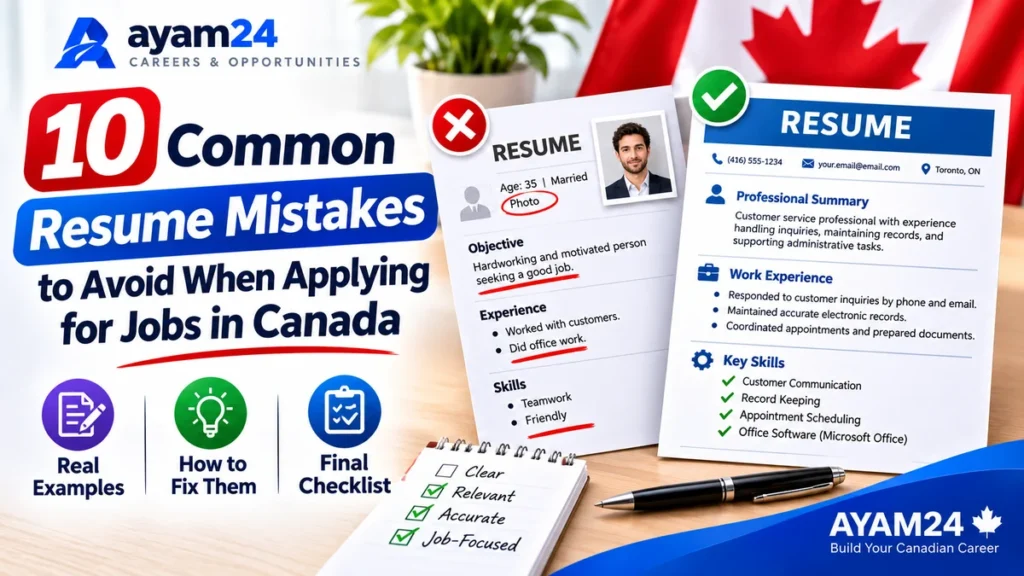
A Practical Before-and-After Resume Improvement
Let’s look at how several small changes can improve the same application.
Imagine a fictional candidate applying for an Administrative Assistant position after working in customer service.
Before Editing
Professional Summary
Hardworking person seeking a good job.
Experience
- Worked with customers.
- Answered calls.
- Helped with paperwork.
Skills
Good communication, motivated, teamwork.
This version doesn’t give the employer enough detail to understand the candidate’s relevant experience.
After Editing
Professional Summary
Customer service professional with experience handling inquiries, maintaining records, and coordinating routine administrative tasks. Familiar with scheduling, document organization, and office communication.
Relevant Experience
- Responded to customer inquiries by phone and email.
- Maintained accurate electronic customer records.
- Prepared routine documents and supported appointment coordination.
Relevant Skills
Customer communication, record keeping, appointment scheduling, document preparation, and office software.
The improved version connects the candidate’s experience with the target role without inventing a new employment history.
Remember: These are fictional examples. Applicants should only use descriptions that match work they have genuinely performed.
Your 10-Minute Resume Review Before Applying
You don’t need to rewrite your entire resume every time you find a vacancy. A focused review can help you catch important issues.
| Time | What to Check |
|---|---|
| 2 minutes | Compare your summary and skills with the job requirements. |
| 3 minutes | Improve vague work experience descriptions and check factual accuracy. |
| 2 minutes | Remove unnecessary information and review formatting. |
| 3 minutes | Proofread, confirm contact details, and check the application instructions. |
This review is a practical starting point. More complicated applications may require additional time and customization.
Frequently Asked Questions About Canadian Resume Mistakes
Is It Wrong to Use a Resume Template in Canada?
No. A template can help organize information and maintain consistent formatting. The important part is adapting the content to your real experience and the job requirements.
Should a Canadian Resume Include a Photograph?
Generally, no. For most standard Canadian job applications, photographs are unnecessary. Job Bank advises applicants not to include them.
Can I Use International Work Experience?
Yes. Relevant international experience can be included. Describe your responsibilities and qualifications clearly, and avoid claiming Canadian credentials or work authorization you do not possess.
Is a Two-Page Resume Too Long?
Not necessarily. For many ordinary job applications, one or two pages can be appropriate. The ideal length depends on relevant experience and the employer’s requirements. Some specialized applications may need more detail.
Should I Put References on My Resume?
Job Bank generally recommends keeping references separate and providing them when requested. This allows you to focus the resume on qualifications and experience.
Will an ATS Automatically Reject a Resume With Tables or Columns?
No universal rule applies to every ATS. Different systems process documents differently. Simple formatting is a practical choice when you cannot verify how a recruitment system handles more complex layouts.
Can I Use AI to Improve My Resume?
AI tools can help improve wording, structure, and clarity. However, you should review every sentence and remove invented responsibilities, results, or qualifications. The final resume must represent your real experience.
What If I Have Gaps in My Employment History?
Use accurate employment dates. Focus on relevant qualifications and be prepared to explain your career history if an employer asks. Do not invent employment to conceal a gap.
Final Resume Checklist
- My resume is tailored to the position.
- My professional summary contains useful, specific information.
- My work experience descriptions explain what I actually did.
- Every achievement, date, and qualification is accurate.
- I have removed unnecessary personal information.
- The layout is clean and easy to read.
- Relevant recent experience is emphasized.
- My international experience and qualifications are described accurately.
- My contact details and final document are correct.
- I have followed every application instruction.
Final Thoughts
A stronger resume isn’t necessarily a longer or more impressive-looking document. It is one that helps an employer quickly understand your relevant qualifications.
Most of the mistakes in this guide can be corrected through careful editing: remove irrelevant information, describe your work clearly, verify your claims, and adapt the document to the position you want.
Before sending your next application, review your resume against the ten points above. Small improvements in clarity and accuracy can make your professional experience easier to evaluate.
Related AYAM24 Resume Guides
Continue improving your application with these related articles:
- How to Write a Canadian-Style Resume (With Examples)
- Free Canadian Resume Templates (Word & PDF)
- How to Write a Cover Letter for Jobs in Canada
Official Sources and Further Reading
- Government of Canada Job Bank — How to Write a Good Resume
- Job Bank — Applying for Jobs
- Job Bank — Foreign Candidates
- Public Service Commission — Applying for Government of Canada Jobs
Editorial review: November 9, 2026. This article provides general career guidance. Employers, regulated professions, and specific recruitment programs may have additional requirements. All examples are illustrative.