
Finding an employer willing to hire you in Canada is an important step. But if you are a foreign national, a job offer alone may not give you permission to start working.
In most cases, you need the appropriate Canadian work authorization. The type of permit you may qualify for, the documents required, and the application process depend on your individual circumstances.
That is why understanding the Canada work permit system matters before you make decisions about employment, travel, or relocation.
This guide explains the two main types of Canadian work permits, who may qualify, how Labour Market Impact Assessments (LMIAs) fit into the process, and how to apply for a work permit from outside Canada.
You’ll also find information about application fees, supporting documents, medical examinations, biometrics, work permits for family members, common mistakes, and your rights as a foreign worker.
Important: This article provides general immigration and employment information, not individualized legal advice. Work permit rules and eligibility requirements vary by program and can change. Always check the current instructions from Immigration, Refugees and Citizenship Canada (IRCC).
What Is a Canada Work Permit?
A Canadian work permit is an immigration document that authorizes a foreign national to work in Canada under specified conditions.
Depending on the permit, those conditions may limit the employer you can work for, the occupation you can perform, the location where you can work, or the period of authorized employment.
Most foreign nationals need a work permit to work temporarily in Canada, although limited exceptions exist for particular activities or circumstances.
A work permit is different from a visitor visa, electronic travel authorization (eTA), or permanent resident status.
Official resource: IRCC — Find Out What Type of Work Permit You Need.
What Are the Two Main Types of Work Permits in Canada?
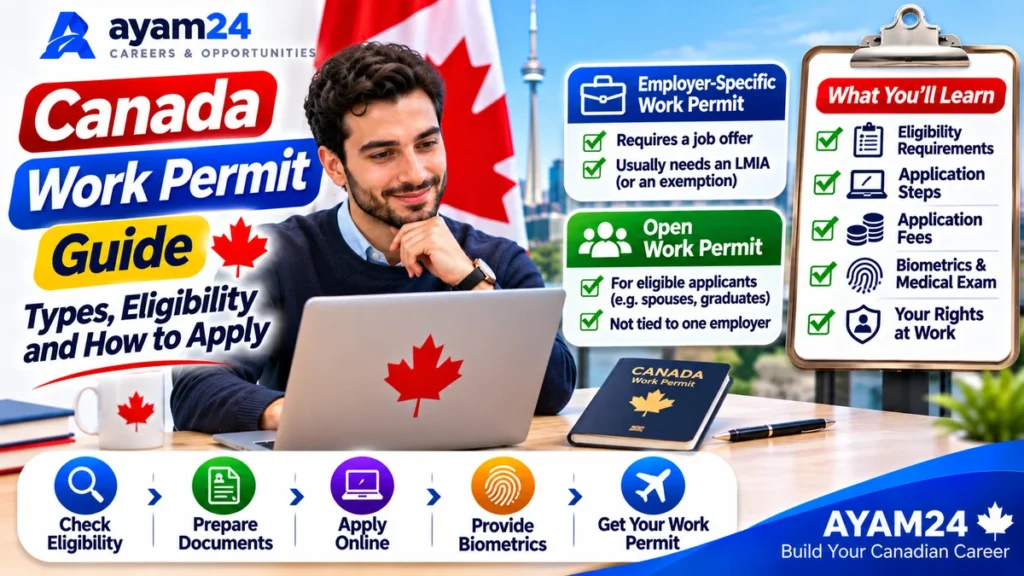
IRCC identifies two principal categories:
- Employer-Specific Work Permit: Authorizes work under the conditions associated with a particular employer and job.
- Open Work Permit: Allows eligible individuals to work for a range of employers, subject to restrictions and permit conditions.
The category you qualify for is determined by the applicable immigration rules. You cannot automatically choose an open permit simply because it offers greater flexibility.
Canada Work Permit Types Compared
| Employer-Specific Permit | Open Work Permit |
|---|---|
| Requires a qualifying job offer. | Generally does not require a job offer. |
| May require an employer LMIA or an exemption. | Does not require an employer LMIA. |
| Employment is subject to employer and other listed conditions. | Generally permits work for most eligible employers. |
| Changing employers may require a new permit or specific authorization. | Changing employers is generally possible while the permit remains valid, subject to its restrictions. |
1. Employer-Specific Work Permit: How It Works
An employer-specific work permit, sometimes called a closed work permit, allows a foreign worker to work according to the conditions listed on the permit.
These conditions can identify the employer, occupation, location, and validity period.
Before you apply, the employer generally needs to complete the required hiring steps. Which steps apply depends on whether the position requires an LMIA.
When an LMIA Is Required
A Labour Market Impact Assessment is an employer-side assessment used in certain foreign worker hiring arrangements.
If the position requires a positive LMIA, the employer must obtain the relevant assessment and provide the necessary supporting documents for the worker’s application.
However, an approved LMIA is not itself a work permit.
When an LMIA Exemption Applies
Some employer-specific work permit categories are exempt from the LMIA requirement.
For many LMIA-exempt arrangements, the employer must submit the required employment information through the IRCC Employer Portal and provide an offer of employment number.
Special requirements or exemptions may apply depending on the program.
Official reference: IRCC — Employer-Specific Work Permits.
2. Open Work Permit: Who May Qualify?
An open work permit provides greater employment flexibility because it is not normally tied to one employer.
However, it is only available to applicants who qualify under specific immigration categories.
Depending on current rules, eligible situations may include certain:
- Post-graduation work permit applicants.
- International Experience Canada Working Holiday participants.
- Spouses or common-law partners who meet applicable eligibility criteria.
- Permanent residence applicants under qualifying programs.
- Refugees, asylum claimants, or protected persons.
- Foreign workers eligible for special protection because of workplace abuse.
Each category has its own requirements. Being the spouse of a student or worker does not automatically guarantee an open work permit.
For example, changes introduced on January 21, 2025, restricted eligibility for certain family open work permits, with additional program-specific rules and exceptions.
Most people applying from outside Canada cannot obtain an open work permit unless they qualify under an eligible category.
Official reference: IRCC — Open Work Permits and Eligibility.
3. Who Is Eligible to Apply for a Canadian Work Permit?
Eligibility is determined by both general immigration requirements and the rules of the specific permit category.
When applying from outside Canada, you may need to demonstrate that you:
- Meet the eligibility requirements for your chosen work permit category.
- Have the required job offer and employer documents, when applicable.
- Have a valid passport or acceptable travel document.
- Have sufficient financial resources for your circumstances.
- Meet admissibility and other immigration requirements.
- Meet the qualifications necessary to perform the proposed work.
- Will comply with the conditions of your authorized stay.
- Complete any required medical examination or biometric collection.
Additional requirements may apply depending on your country of residence, occupation, immigration program, and family situation.
There is no universal document package or single financial amount that applies to every work permit applicant.
Consult IRCC’s eligibility requirements for applicants outside Canada before preparing your application.
4. How to Apply for a Canada Work Permit From Outside Canada
For many international applicants, the work permit process begins before they travel to Canada.
The following steps describe the general online application process. Specific programs may have additional or different instructions.
Step 1: Identify the Correct Work Permit Category
Before creating an application, determine which permit category may apply to you.
If you have a Canadian employer willing to hire you, an employer-specific permit may be relevant.
If you qualify under a specific open work permit category, you may have a different application pathway.
Use the official IRCC work permit eligibility tool rather than choosing a category based only on an advertisement.
Step 2: Obtain the Required Employer Documents
If you are applying for an employer-specific work permit, confirm that the employer has completed the required hiring process.
Depending on the program, you may need:
- A written job offer or employment agreement.
- Relevant positive LMIA documentation, when required.
- An offer of employment number for certain LMIA-exempt applications.
- Other supporting documents specific to the occupation or immigration pathway.
Do not assume that a pending LMIA, a verbal job offer, or an email promising sponsorship is sufficient to submit a complete application.
Step 3: Create or Access Your IRCC Account
Open the official page for applying from outside Canada:
Apply for a Work Permit From Outside Canada — IRCC
Follow the instructions to sign in or create the appropriate secure account.
Answer the eligibility and application questions accurately. These answers help determine which forms and supporting documents you must submit.
Step 4: Prepare Your Application Documents
IRCC provides a personalized document checklist through the online application process.
For an application made outside Canada, common documents include:
- The required work permit application form, such as IMM 1295.
- A valid passport or travel document.
- Photographs meeting the relevant specifications, when required.
- Documents supporting the employment offer.
- Proof of qualifications or relevant employment experience.
- Additional documents required by the responsible visa office.
- Other evidence requested for your specific circumstances.
Depending on the application, supporting documents may include educational records, employment letters, professional credentials, proof of funds, or other evidence.
The exact checklist generated for your application takes priority over a general article like this one.
Official document guide: IRCC — Work Permit Forms and Documents.
Step 5: Complete the Forms Carefully
Enter your personal details, employment history, travel information, and application answers truthfully.
Make sure names, dates, passport details, and information about your proposed job are consistent across the application and supporting documents.
If IRCC asks for translations, explanations, or country-specific documents, follow the applicable instructions.
Do not invent employment experience, qualifications, family information, or immigration history.
Step 6: Pay the Required Application Fees
The fees depend on the permit type and whether biometrics or other services are required.
As listed on IRCC’s application instructions reviewed on November 9, 2026, common fees include:
| Fee | Amount (CAD) |
|---|---|
| Work permit processing | $155 |
| Additional open work permit holder fee, when applicable | $100 |
| Biometrics for one individual, when required | $85 |
Fee exemptions and special rules may apply. Family applications and other immigration services can involve different costs.
Always check the amount displayed by IRCC when submitting your application. Do not rely on an outdated fee table.
Step 7: Submit Your Application
Upload the requested documents, review your answers, pay the applicable fees, and follow the portal’s instructions to submit the application.
Incomplete or inaccurate applications may be delayed, returned, or refused depending on the circumstances.
Keep your application confirmation and any instructions issued through your account.
Step 8: Provide Biometrics if Required
Many applicants must provide fingerprints and a photograph as part of the immigration process.
If you need to provide biometrics, wait for the official Biometric Instruction Letter and follow its instructions to arrange an appointment at an authorized collection location.
Do not assume that previously submitted biometrics are always sufficient. IRCC may require new biometrics in certain circumstances.
Step 9: Respond to Additional IRCC Requests
During processing, IRCC may ask for more documents, a medical examination, or other information.
Check your account and official communications regularly.
Respond within the instructions and deadlines provided.
Step 10: Review the Decision and Prepare for Travel
If IRCC approves your application from outside Canada, you will generally receive a Port of Entry Letter of Introduction (LOI).
The Letter of Introduction is not the actual work permit.
You must present the required documents when arriving in Canada. A border services officer makes the applicable entry and work permit issuance decisions.
You may also need a visitor visa or eTA depending on your circumstances. IRCC explains how these documents are handled when a work permit application is approved.
Review IRCC’s arrival instructions before travelling.
5. Is a Job Offer Enough to Get a Canadian Work Permit?
No. A job offer can be necessary for certain permit categories, but it does not guarantee approval.
IRCC still needs to assess the applicant’s eligibility, admissibility, documents, and the applicable immigration requirements.
If an LMIA is required, the employer generally needs to complete the relevant process. If an exemption applies, the employer may need to provide different documents.
A genuine job offer is therefore one part of the process, not a substitute for a work permit decision.
6. Does a Visitor Visa Allow You to Work in Canada?
No. A visitor visa or electronic travel authorization (eTA) does not, by itself, authorize employment in Canada.
Most visitors also cannot simply apply for a work permit from inside Canada without meeting a specific eligible category or exception.
If you are considering travelling to Canada as a visitor, do not assume you can begin employment after finding an interested employer.
Working without authorization can have serious immigration consequences.
Official reference: IRCC — Consequences of Unauthorized Work.
7. How Long Does Canada Work Permit Processing Take?
There is no single processing time that applies to every applicant.
Processing times can depend on the immigration category, country of application, completeness of documents, medical or biometric requirements, and other factors.
Some qualifying applications may receive priority processing. However, that does not mean every applicant qualifies for accelerated service.
Use IRCC’s official processing time tool for an updated estimate relevant to your application.
A published processing time is an estimate, not a guaranteed approval date.
Avoid making irreversible travel or employment commitments based solely on an expected processing time.
8. Can Your Spouse or Family Members Come to Canada?
Some foreign workers may be able to bring eligible family members to Canada.
However, a family member’s ability to visit, study, or work depends on the applicable immigration rules and their individual eligibility.
For example, an eligible spouse or common-law partner may qualify for an open work permit under certain programs.
But family work permit eligibility has been restricted for several categories, and not every spouse or dependent child qualifies.
Do not assume that receiving your own work permit automatically gives your partner permission to work.
Check IRCC — Open Work Permit Eligibility for Family Members.
9. Can You Change Employers With a Canadian Work Permit?
Your options depend on the type of work permit you hold and the conditions listed on it.
If You Have an Employer-Specific Permit
You generally need to apply for a new work permit before working for a different employer.
In certain circumstances, eligible workers already in Canada can request authorization to begin working for a new employer while their new employer-specific work permit application is being processed.
That authorization is not automatic. You must follow the applicable procedure and wait for the required authorization before using it.
If You Have an Open Work Permit
You can generally change employers while your permit is valid, subject to any restrictions listed on the permit and the applicable rules.
Official guide: IRCC — Changing Jobs or Employers.
10. What Rights Do Foreign Workers Have in Canada?
Foreign workers are protected by applicable Canadian employment laws and immigration program rules.
Workers under the Temporary Foreign Worker Program have specific protections concerning employment conditions, recruitment fees, workplace safety, and employer conduct.
For example, employers must not confiscate a worker’s passport or charge prohibited recruitment fees under the applicable program rules.
Workers should receive the wages and working conditions required by their employment arrangements and the law that applies.
If you experience abuse, unsafe working conditions, or threats, official assistance and reporting options are available.
Some vulnerable workers may qualify for a special open work permit under the applicable immigration rules.
Official reference: Government of Canada — Temporary Foreign Workers’ Rights.
11. Common Canadian Work Permit Mistakes to Avoid
Mistake 1: Applying for the Wrong Permit Category
An open work permit and an employer-specific permit have different requirements. Check your eligibility before submitting the application.
Mistake 2: Assuming an LMIA Is a Work Permit
An LMIA is part of an employer’s hiring process. It does not give a worker permission to start employment.
Mistake 3: Using Incomplete or Incorrect Documents
Follow your personalized IRCC document checklist. Check the validity of your passport and the consistency of your personal and employment information.
Mistake 4: Relying on a Guaranteed Visa Promise
No recruiter or employer can guarantee that IRCC will approve an application.
Mistake 5: Paying an Employer for an LMIA
Be cautious of anyone asking you to purchase an LMIA or pay a prohibited recruitment fee to secure employment.
Mistake 6: Assuming a Visitor Visa Allows Employment
A visitor visa or eTA does not automatically authorize work in Canada.
Mistake 7: Confusing Application Approval With the Physical Permit
For many successful applications from outside Canada, the approval letter is presented on arrival, and the actual permit is issued at the port of entry.
Mistake 8: Ignoring Permit Conditions
Check the employer, occupation, location, expiry date, and other conditions listed on your permit before starting or changing work.
12. Two Practical Examples of Canadian Work Permit Situations
Example A: Warehouse Worker Applying From Abroad
Imagine a fictional candidate living outside Canada who has several years of warehouse experience.
The candidate finds a legitimate Canadian employer recruiting for a position that requires a positive LMIA.
If selected, the candidate needs to verify the offer, obtain the appropriate employer documentation, and follow IRCC’s process for an employer-specific work permit.
The candidate cannot legally begin the job simply because the employer has offered employment or received a positive LMIA.
IRCC must still assess the individual’s application.
Example B: Applicant Eligible for an Open Work Permit
Consider another fictional candidate who may qualify for an open work permit under a specific eligible immigration program.
That candidate must confirm the program requirements, gather the relevant documents, and complete the appropriate application process.
If approved and issued a valid open work permit, the candidate may generally work for eligible employers within the permit’s conditions.
The important difference is that open work permit eligibility comes from a qualifying immigration category, not simply from wanting to work for multiple companies.
13. Canada Work Permit Application Checklist
Use this checklist to organize your preparation.
- I have identified the work permit category that applies to my circumstances.
- I have checked the latest IRCC eligibility requirements.
- I have obtained the required employer documents, if applicable.
- My passport is valid.
- I understand any professional licensing requirements.
- I have reviewed my personalized document checklist.
- My application forms contain accurate information.
- I understand the current fees and applicable exemptions.
- I have checked whether biometrics or a medical examination is required.
- I have retained my submission confirmation.
- I know how to check my application status.
- I understand that an approval letter is not the work permit itself.
- I have reviewed arrival instructions and permit conditions.
- I have not relied on promises of guaranteed employment or approval.
Frequently Asked Questions About Canada Work Permits
Can I Apply for a Canada Work Permit Without a Job Offer?
Some applicants qualify for open work permits that do not require a job offer. However, those permits are available only under specific eligibility categories. An employer-specific permit generally requires a qualifying job offer.
Can I Apply for a Canadian Work Permit From My Home Country?
Yes, if you meet the requirements to apply from outside Canada. Follow IRCC’s instructions and any applicable country-specific document requirements.
Do I Need an LMIA for Every Work Permit?
No. Certain employer-specific work permit programs are LMIA-exempt, and open work permits do not require an LMIA. Eligibility and employer obligations depend on the relevant category.
Can I Get a Work Permit With an Approved LMIA?
A positive LMIA can support an eligible employer-specific work permit application, but it does not guarantee approval. IRCC assesses the individual application separately.
Is a Canadian Work Permit the Same as Permanent Residence?
No. A work permit normally authorizes temporary employment under specified conditions. Permanent residence is a separate immigration status with its own eligibility requirements.
How Much Does a Canadian Work Permit Cost?
IRCC’s general work permit processing fee listed in November 2026 is CAD $155, with additional fees for certain open work permits and biometrics when applicable. Check the official fee schedule when applying.
Can I Work in Canada on a Visitor Visa?
A visitor visa alone does not authorize employment. Most foreign nationals need a work permit or must fall within a specific work permit exemption.
How Long Is a Canadian Work Permit Valid?
Validity depends on factors such as the permit category, applicable employment arrangements, passport validity, biometrics, and immigration rules. There is no single duration guaranteed for every applicant.
Can My Spouse Work in Canada if I Have a Work Permit?
Possibly, but only if your spouse independently meets the criteria for an eligible work permit category. Family open work permit eligibility is restricted in several circumstances.
Can I Change Employers After Receiving My Permit?
This depends on the permit. Employer-specific permit holders generally need a new permit or applicable authorization before changing employers. Open work permit holders generally have greater flexibility.
Does an Approval Letter Mean I Can Start Working?
Not by itself. For a typical approved application submitted outside Canada, the Port of Entry Letter of Introduction is not the actual work permit. You must follow the arrival and permit issuance process.
Does a Work Permit Guarantee Permanent Residence?
No. Some workers may later qualify for permanent residence programs, but eligibility depends on the requirements of those separate programs.
Final Thoughts
Applying for a Canada work permit is not simply a matter of finding an employer and submitting a resume.
You need to understand which authorization category applies, whether the employer has completed the required steps, which documents IRCC requests, and what conditions will govern your employment.
For applicants outside Canada, the safest approach is to begin with official IRCC information, verify any employer and job offer, and follow the specific instructions generated for your application.
A work permit application requires accurate information, complete documentation, and realistic expectations. No job offer, LMIA, or recruiter can guarantee approval.
By understanding the process before making travel or financial commitments, you can make better-informed decisions about working in Canada.
Related AYAM24 Working in Canada Guides
Continue learning about Canadian employment and job applications with these guides:
- How to Find a Job in Canada as a Foreigner: Step-by-Step Guide
- LMIA Jobs in Canada: How to Find Legitimate Employers and Apply
- How to Write a Canadian-Style Resume (With Examples)
- 20 Questions to Ask Before Accepting a Job Offer in Canada
Official Sources and Further Reading
- IRCC — Find Out What Type of Work Permit You Need
- IRCC — Employer-Specific Work Permits
- IRCC — Open Work Permits
- IRCC — Eligibility for Work Permits From Outside Canada
- IRCC — Work Permit Forms and Supporting Documents
- IRCC — How to Apply From Outside Canada
- IRCC — Preparing for Arrival After Work Permit Approval
- Government of Canada — Temporary Foreign Workers’ Rights
Editorial review: November 9, 2026. This article contains general information about Canadian work permits. Eligibility, fees, immigration procedures, employment conditions, and family work permit rules may change. Always consult current IRCC instructions. AYAM24 does not guarantee employment, visas, work permits, or permanent residence.