
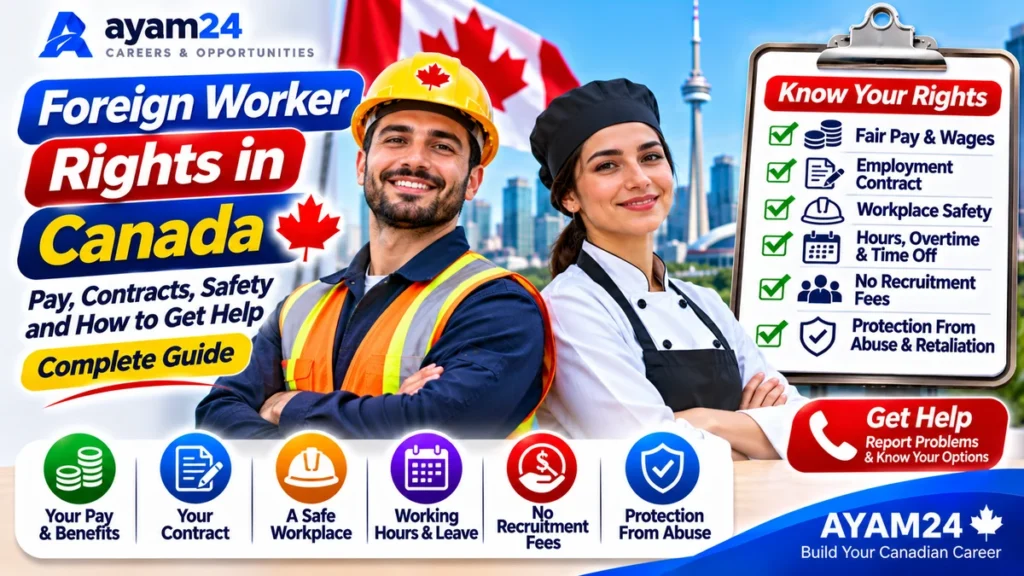
Starting a job in another country can be exciting, but it can also raise important questions. How much should you be paid? Can your employer keep your passport? What happens if your working hours are different from those in your contract? And where can you get help if something goes wrong?
These are not minor details. Understanding your rights can help you recognize problems, protect your income, and make informed decisions about your employment.
In Canada, foreign workers are protected by applicable employment and workplace safety laws. Employers cannot simply ignore those protections because a worker has temporary immigration status.
This guide explains foreign worker rights in Canada, including wages, overtime, employment agreements, recruitment fees, workplace safety, personal documents, health care, and protection from abuse.
You’ll also learn how to identify the employment standards that apply to your job, report possible violations, and find official assistance.
Important: Employment rules vary by jurisdiction, industry, immigration program, and individual circumstances. This article provides general information, not personalized employment or immigration legal advice.
Do Foreign Workers Have the Same Employment Rights as Canadians?
Foreign workers in Canada have protections under Canadian labour and employment laws.
According to Immigration, Refugees and Citizenship Canada (IRCC), temporary foreign workers are protected by Canadian labour laws, including requirements concerning pay, workplace safety, and access to employment standards authorities.
An employer cannot take away these legal protections simply because an employee is not a Canadian citizen or permanent resident.
However, not every worker has identical contractual benefits or immigration conditions. Employment rights depend on the laws that apply to the workplace, while permission to work depends on the worker’s immigration status.
For official information, see IRCC — Temporary Foreign Worker Rights and Labour Standards.
Which Foreign Worker Program Applies to Your Job?
Before reviewing your rights, it helps to understand the program through which your employer hired you.
Temporary Foreign Worker Program (TFWP)
The Temporary Foreign Worker Program generally involves employers hiring foreign workers for positions that require a Labour Market Impact Assessment (LMIA).
Employers participating in this program must meet specific obligations related to employment agreements, wages, recruitment practices, workplace conditions, and worker protections.
The Government of Canada provides a detailed guide called Temporary Foreign Workers: Your Rights Are Protected.
International Mobility Program (IMP)
The International Mobility Program includes certain LMIA-exempt employment arrangements.
Employers hiring foreign workers through this program also have compliance obligations. These include providing the required employment agreement, respecting employment conditions, and following applicable labour laws.
See the official International Mobility Program Workers’ Rights Guide.
Remember: A requirement that applies to one program does not necessarily apply in exactly the same way to every immigration or employment arrangement.
Federal vs Provincial Employment Standards in Canada
One of the most important things to understand is that Canada does not have a single employment standards law covering every workplace in the same way.
Many employees are covered by provincial or territorial employment standards. Others work in federally regulated industries.
Federally Regulated Workplaces
Examples of federally regulated industries include certain:
- Banks.
- Air transportation companies.
- Telecommunications businesses.
- Interprovincial and international road transportation companies.
- Railways crossing provincial or international borders.
- Postal and courier operations.
- Marine shipping and related transportation services.
Workers in these sectors may be covered by federal labour standards under the Canada Labour Code.
Provincially or Territorially Regulated Workplaces
Many other employees, including those working in retail, hospitality, local services, construction, and numerous other businesses, are covered by the employment standards of their province or territory.
The exact classification depends on the employer’s activities and other legal factors.
This matters because minimum wages, overtime thresholds, paid leave, vacation entitlements, and termination requirements can differ.
Official reference: Government of Canada — Federally Regulated Industries and Provincial Employment Standards.
1. Your Right to Be Paid for Your Work
One of the most basic employment protections is the right to receive the wages you are legally owed.
Your employer must comply with the applicable wage requirements and relevant employment agreement.
For workers hired through the Temporary Foreign Worker Program, the employer must respect the wages and working conditions required under the applicable program and employment agreement.
What Should You Check?
- Your agreed hourly wage or salary.
- The number of hours you actually worked.
- Your regular pay schedule.
- Any applicable overtime or premium pay.
- Authorized deductions.
- The amount you actually received.
Example: Imagine a fictional employee whose agreement provides CAD $20 per hour and who works 35 regular hours during a pay period.
The basic gross wages for those hours would be CAD $700 before applicable deductions, assuming all 35 hours are payable at the ordinary rate and no other adjustments apply.
If the actual payment is lower, the employee should review the hours, pay records, lawful deductions, and any applicable adjustments before determining whether there is an error.
The example is for illustration only. It is not a statement of the minimum wage in any Canadian province.
What If You Are Not Paid Correctly?
Keep a record of your working hours, pay statements, and employment agreement.
If it is safe and appropriate, you can ask payroll or the employer to explain the difference.
If the issue is not resolved, or if the situation involves threats or abuse, contact the appropriate employment standards authority or official worker protection service.
2. Your Rights Concerning Working Hours and Overtime
Working hours and overtime rules vary across Canada.
For many employees in federally regulated workplaces, standard hours are generally eight hours per day and 40 hours per week, subject to specific exceptions, modified arrangements, and other rules.
These thresholds do not automatically apply to every workplace in Canada.
Some provinces have different overtime rules, and certain occupations or employment arrangements have special provisions.
Questions to Ask About Your Schedule
- How many hours am I expected to work each week?
- Is the schedule fixed or variable?
- When do overtime rules apply to this job?
- How is overtime recorded and compensated?
- What meal breaks and rest periods apply?
- Can my schedule change, and what notice rules apply?
An employer cannot disregard applicable minimum employment standards simply by putting a different condition in a contract.
However, legal entitlements depend on the employment jurisdiction and the specific role.
For official federal information, consult Federal Labour Standards — Hours of Work.
3. Your Right to Understand Your Employment Agreement
Before accepting a position, make sure you understand the employment terms.
An agreement should make important conditions clear, including the position, wages, responsibilities, work location, and other relevant terms.
Under the Temporary Foreign Worker Program, employers must provide workers with a signed employment agreement on or before their first day of work. The agreement must reflect the relevant occupation, wages, and working conditions.
For workers under the International Mobility Program, specific rules require employers to provide the signed employment agreement before the worker applies for the work permit.
Do not assume that the timing and documentation rules are identical for every work permit category.
Employment Agreement Checklist
| Item | What to confirm |
|---|---|
| Employer | Legal name and contact information |
| Occupation | Job title and expected duties |
| Pay | Wage or salary and pay schedule |
| Hours | Expected schedule and overtime arrangements |
| Work location | Where the work will be performed |
| Additional terms | Benefits, duration, accommodation, and other conditions when applicable |
Keep a personal copy of your agreement and related employment documents in a secure place.
4. Protection From Prohibited Recruitment Fees
Job seekers interested in working in Canada may encounter recruiters offering guaranteed job contracts or LMIA approvals in exchange for money.
Workers should understand the difference between legitimate personal immigration application costs and prohibited recruitment fees.
Under the Temporary Foreign Worker Program, employers and recruiters acting on their behalf cannot charge or recover prohibited recruitment fees from the worker.
Employers also cannot pass prohibited LMIA-related employer costs to the worker.
At the same time, applicants may have legitimate government fees for their own work permit applications, biometrics, or medical examinations, depending on their circumstances.
Warning Signs
- Someone offers to sell you an approved LMIA.
- A recruiter demands a payment to guarantee a job.
- An employer asks you to reimburse prohibited recruitment expenses.
- You are promised a work permit approval in exchange for an upfront fee.
- You are pressured to send money before verifying the employer.
If you are asked to pay a recruitment-related charge, verify its legality through official government information before making any payment.
Official guidance: Temporary Foreign Worker Protections.
5. Your Employer Cannot Confiscate Your Passport or Work Permit
Your employer cannot take away and keep your passport, work permit, or other personal documents as a way of controlling your employment.
This is an important protection because those documents may be necessary to establish your identity, access services, or address immigration matters.
If an employer offers to store a document for you, do not assume you are required to surrender control of it.
You should be able to retain access to your personal documents.
Threats involving a worker’s passport or immigration status may indicate serious abuse.
If someone refuses to return your documents, consider contacting the appropriate government service, police, or qualified worker support organization, depending on the urgency of the situation.
6. Your Right to a Safe Workplace
Canadian employers have occupational health and safety obligations.
Workers should receive the information, training, and protective measures required for the duties they perform.
For example, an employee operating machinery may need appropriate training and authorization. A worker handling hazardous materials may require specific safety instructions and protective equipment.
What If You Believe a Task Is Dangerous?
Do not assume you must perform dangerous work simply because a supervisor tells you to do so.
Canadian occupational health and safety laws provide protections concerning unsafe work, although the precise refusal procedures and exceptions differ by jurisdiction and occupation.
Follow the applicable reporting and work-refusal process, including notifying the appropriate supervisor or authority when required.
If there is an immediate emergency, contact emergency services.
Official guidance: Government of Canada — Occupational Health and Safety.
7. Health Care and Workplace Injuries
Foreign workers should understand the health coverage and workplace injury rules that apply to them.
Eligibility for provincial or territorial health insurance depends on the jurisdiction and individual circumstances.
Some workers may experience a waiting period or need separate coverage before becoming eligible for public health insurance.
Under the Temporary Foreign Worker Program, employers have specific obligations concerning private emergency medical coverage when workers are not yet covered by the relevant provincial or territorial system, subject to program-specific exceptions.
Workers may also have access to workers’ compensation protections when injuries or occupational illnesses occur.
What to Do After a Workplace Injury
- Seek urgent medical assistance when necessary.
- Report the incident through the appropriate workplace procedure.
- Keep relevant medical and incident documentation.
- Find out which workers’ compensation system applies.
- Contact the relevant authority if you believe your rights are being denied.
Your employer does not have the right to prevent you from seeking appropriate medical assistance or making a lawful workers’ compensation claim.
For specific coverage and reporting requirements, consult the responsible provincial, territorial, or federal authority.
8. Vacation, Public Holidays, Sick Leave and Other Time Off
Canadian employment standards establish various minimum entitlements concerning vacation, public holidays, and protected leaves.
However, the details are not identical throughout the country.
Some rules differ depending on how long you have worked for an employer, the type of position, or the employment jurisdiction.
Questions Worth Asking
- How is annual vacation calculated?
- How is vacation pay provided?
- Which public holidays apply to this position?
- What happens if I work on a public holiday?
- What sick leave protections apply?
- Are additional paid benefits provided by the employer?
Do not assume that every temporary foreign worker receives the same number of paid sick days or vacation weeks.
Check the legislation that applies to your workplace, together with any additional contractual benefits.
For federally regulated employment, consult Federal Labour Standards — Vacation and Holidays.
9. Protection From Abuse, Harassment and Retaliation
Abuse can take different forms. It does not always involve physical violence.
Government guidance identifies potential abuse such as threats, intimidation, financial exploitation, harassment, isolation, and punishment for reporting wrongdoing.
Examples may include:
- Threatening to have a worker deported for asking about their rights.
- Taking or refusing to return a worker’s passport.
- Withholding wages to control the worker.
- Threatening punishment for reporting unsafe conditions.
- Preventing a worker from leaving an employer-provided residence.
- Harassment or abusive conduct at work.
An employer cannot personally deport a worker or unilaterally change their immigration status.
However, losing employment can affect a person’s practical immigration situation, particularly when they hold an employer-specific work permit. Workers facing these circumstances may need advice about their permit conditions and available protections.
Protecting your employment rights and complying with immigration conditions are related but separate issues.
10. Can a Foreign Worker Change Employers in Canada?
Foreign workers are not automatically required to remain with an abusive employer.
However, the authorization needed to begin a new job depends on the worker’s immigration status.
Employer-Specific Work Permit
If you hold an employer-specific work permit, it normally authorizes employment under the conditions written on that permit.
Changing employers generally requires a new work permit or another applicable authorization before starting the new job.
Open Work Permit
An eligible open work permit holder generally has more flexibility to work for different employers, subject to the permit’s restrictions.
Open Work Permit for Vulnerable Workers
IRCC provides a special temporary open work permit pathway for certain workers experiencing or at risk of abuse related to their employment in Canada.
Eligibility includes specific conditions. For example, the applicant generally must be in Canada and hold a valid employer-specific work permit or meet the relevant conditions while awaiting a timely extension decision.
This protection is not automatically available to every foreign worker, and it does not apply to someone simply seeking their first Canadian job from abroad.
Official resource: IRCC — Open Work Permit for Vulnerable Workers.
How to Report Abuse of Temporary Foreign Workers in Canada
If you are experiencing workplace abuse or believe an employer is violating program requirements, official reporting options are available.
You do not need to assume that every problem must be reported to the same authority.
For example, a wage dispute may fall under provincial employment standards, while an employer’s violation of Temporary Foreign Worker Program obligations may also be reportable to Service Canada.
Step 1: Identify the Problem
Write down what happened, including relevant dates, people involved, and the employment conditions affected.
Keep the description factual. You do not need to exaggerate the circumstances.
Step 2: Preserve Relevant Information Safely
When safe and lawful, keep copies of your employment agreement, pay statements, schedules, messages, and other relevant records.
Do not put yourself at risk trying to obtain evidence, and do not access documents or systems you are not authorized to use.
Step 3: Contact Service Canada When Appropriate
Service Canada provides a confidential reporting service for possible abuse of temporary foreign workers.
Service Canada — Temporary Foreign Worker Abuse Reporting
Telephone: 1-866-602-9448
Reports can be submitted through the official online form or by telephone.
The telephone service accepts messages at any time; access to live agents follows published service hours. Assistance is available in numerous languages.
Official reporting page:
Report Abuse of Temporary Foreign Workers
Government guidance states that reports are handled confidentially and that people can report concerns without providing their name.
Confidentiality protections do not mean that every detail of an investigation will be disclosed to the person making the report.
Step 4: Contact Your Employment Standards Authority
For issues involving pay, overtime, leave, or other employment standards, the appropriate office often depends on the province or territory in which you work.
If you work in a federally regulated workplace, the federal Labour Program may be the appropriate authority.
Federal Labour Program telephone: 1-800-641-4049.
To identify provincial or territorial employment standards authorities, use IRCC’s official worker rights and labour standards directory.
Step 5: Seek Immediate Help if You Are in Danger
If you face an immediate threat to your safety in Canada, call 9-1-1 or contact local police.
For non-emergency situations, worker support organizations, legal clinics, unions where applicable, and official government services may help you understand your options.
Sample Email: Requesting Clarification About Missing Wages
If the problem appears to be a payroll error and you can safely raise it, you may use a short, professional message.
Do not feel obligated to confront an employer directly when doing so could put you at risk of abuse or retaliation. Official reporting and support services are available.
Subject: Request for Payroll Clarification — [Pay Period]
Dear [Manager or Payroll Contact],
I am writing to request clarification regarding my wages for the pay period from [Start Date] to [End Date].
According to my records, I worked [Number] hours during that period. However, my pay statement appears to reflect a different amount.
Could you please review the hours and deductions and explain how the payment was calculated?
I would appreciate confirmation of any correction required.
Thank you for your assistance.
Best regards,
[Your Full Name]
Replace the placeholders with accurate details. Keep a copy of your communication and any response.
What Documents Should Foreign Workers Keep?
Maintaining organized records can help you understand your employment terms and resolve questions later.
Consider keeping secure copies of the following documents:
- Your signed employment agreement.
- Your work permit and relevant immigration correspondence.
- Pay statements and payroll records.
- Your work schedules and recorded hours.
- Relevant employer communications.
- Professional licences and training certificates.
- Documents relating to workplace injuries, when applicable.
- Written changes to your employment terms.
Store sensitive information securely and avoid sharing it publicly or with unverified third parties.
When Should You Provide Your Social Insurance Number?
A Social Insurance Number (SIN) is used for important employment and government administrative purposes in Canada.
However, it should not be requested as part of an ordinary job application or interview.
Once you are hired, your employer has legal responsibilities concerning collecting your SIN for payroll and related reporting purposes.
Service Canada advises employers not to request a SIN on job applications or during interviews.
Official reference: Social Insurance Number Code of Practice.
Practical Example: A Foreign Worker Notices Incorrect Pay
Consider a fictional worker employed at a warehouse in Canada.
The worker reviews a pay statement and notices that some recorded hours appear to be missing.
The worker could take the following steps:
- Compare the pay statement with personal records of hours worked.
- Review the employment agreement and applicable pay rules.
- Check whether a legitimate payroll adjustment explains the difference.
- If safe, request clarification from payroll or management.
- Keep copies of relevant documents and responses.
- Contact the appropriate employment standards authority if the problem remains unresolved.
- Report threats, abuse, or suspected foreign worker program violations through the relevant official process.
The exact remedies depend on the facts, jurisdiction, and applicable legal requirements.
This example is intended to help readers organize their response to a possible problem, not to replace advice from an appropriate authority.
Frequently Asked Questions About Foreign Worker Rights in Canada
Do Temporary Foreign Workers Have Rights in Canada?
Yes. Foreign workers are protected under applicable Canadian employment laws, workplace safety requirements, and relevant immigration program rules.
Can My Employer Keep My Passport?
No. Employers cannot confiscate or retain your personal identity documents to control you or your employment.
Can My Employer Pay Me Less Than Agreed?
Employers must comply with applicable wage laws and relevant employment agreement obligations. If you believe you are underpaid, review your records and contact the appropriate authority.
Do Foreign Workers Receive Overtime Pay?
Overtime entitlements depend on the employment jurisdiction, occupation, exemptions, and applicable arrangements. Review the rules that cover your job.
Can My Employer Charge Me for an LMIA?
Employers cannot recover prohibited LMIA processing or recruitment costs from foreign workers under the applicable Temporary Foreign Worker Program rules.
Can My Employer Deport Me?
Employers do not have the authority to deport someone or personally change immigration status. However, employment changes may affect permit-related circumstances, so workers should obtain accurate immigration guidance when needed.
Can I Report Abuse Without Giving My Name?
Service Canada allows people to report suspected abuse of temporary foreign workers without identifying themselves. Consult the official reporting instructions for confidentiality details.
What If I Have an Employer-Specific Work Permit?
You must respect the conditions on your permit. Changing employers usually requires a new permit or applicable authorization, but some workers experiencing abuse may qualify for special protection.
Can I Refuse Dangerous Work?
Canadian workplace safety laws provide protections concerning dangerous work. The exact process and exceptions vary, so follow the applicable jurisdiction’s rules and seek help when necessary.
Do Foreign Workers Have Access to Health Care?
Access to public health insurance depends on the province or territory and eligibility. Certain temporary foreign worker programs impose additional employer obligations concerning medical coverage.
Do Workers in Every Canadian Province Have the Same Minimum Wage?
No. Minimum wages and employment standards vary by jurisdiction, and some occupations or sectors have special provisions.
What Is an Open Work Permit for Vulnerable Workers?
It is a special temporary permit pathway available to some eligible workers in Canada who are experiencing or at risk of workplace abuse. The IRCC eligibility requirements must be met.
Can I Join a Union as a Foreign Worker?
Foreign workers have applicable labour rights, including protections concerning lawful union activities. The exact framework depends on the workplace and jurisdiction.
What If My Employer Provides My Housing?
Employer-provided accommodation may be subject to specific housing standards and foreign worker program requirements. Conditions and permitted deductions differ by program and jurisdiction.
Final Foreign Worker Rights Checklist
- I understand which immigration program applies to my employment.
- I know whether my workplace is federally or provincially regulated.
- I have reviewed my signed employment agreement.
- I understand my wage, schedule, and applicable overtime rules.
- I keep my passport and personal documents accessible.
- I know that prohibited recruitment fees cannot be passed to me.
- I understand how to report unsafe working conditions.
- I know which health coverage and workplace injury rules apply.
- I know where to get help if I experience abuse or threats.
- I understand my work permit conditions before changing employers.
- I keep secure copies of important employment records.
- I use official government resources to verify my rights.
Final Thoughts
Foreign workers make important contributions to Canadian workplaces, and their temporary immigration status does not eliminate their employment rights.
Understanding your pay, employment agreement, workplace safety protections, and reporting options can help you recognize when something is wrong and respond appropriately.
The most useful starting point is knowing which rules apply to your workplace. Employment standards differ across jurisdictions, and some foreign worker programs impose additional obligations on employers.
Keep accurate records, use official sources, and seek assistance when you need it. If you are experiencing abuse, you do not have to rely only on the explanations provided by the employer involved.
Knowing your rights is an important part of preparing for a safe and informed working experience in Canada.
Related AYAM24 Working in Canada Guides
Continue learning about employment opportunities, work permits, and job applications in Canada:
- How to Find a Job in Canada as a Foreigner
- LMIA Jobs in Canada: How to Find Legitimate Employers and Apply
- Canada Work Permit Guide: Types, Eligibility and How to Apply
- 20 Questions to Ask Before Accepting a Job Offer in Canada
Official Sources and Further Reading
- Government of Canada — Temporary Foreign Workers: Your Rights Are Protected
- IRCC — Temporary Foreign Worker Rights and Labour Standards
- IRCC — International Mobility Program Worker Rights
- Government of Canada — Federally Regulated Industries and Employment Standards
- Service Canada — Report Abuse of Temporary Foreign Workers
- IRCC — Open Work Permit for Vulnerable Workers
- Government of Canada — Occupational Health and Safety
- Government of Canada — Social Insurance Number Code of Practice
Editorial review: November 9, 2026. This article provides general information about employment rights in Canada. Legal protections, employment standards, immigration conditions, and program obligations may vary. Consult current government guidance or qualified professional advice for individual circumstances.